Thursday, October 13, 2011
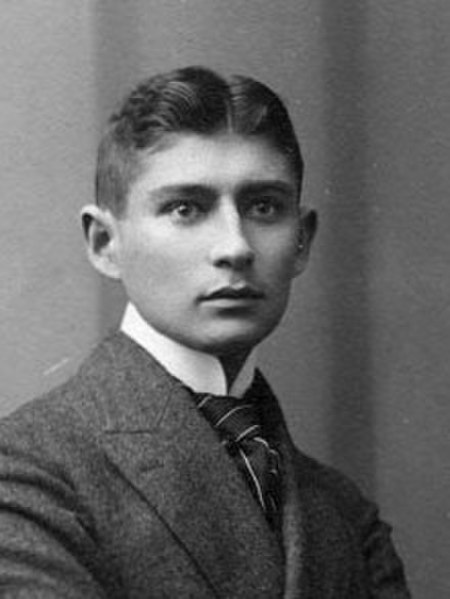
Metamorphosis by Fraz Kafka
I have recently plowed through the Tempest and followed on its heels with the next book on the list, Metamorphosis. Just to let you know, I did both before firing up the blog again - I can't read THAT fast. (In fact, I began reading The Idiot last night so I am already onto the next title.) Well, even though I am trying to play catch up, I will still do my usual preamble with some background info on the author and book.
Franz Kafka was born in July of 1883 to a Middle class, German-speaking Jewish family in Prague. (The country was not yet considered The Czech Republic at this time but was considered Bohemia, part of Austria-Hungary.) He would be the eldest of two other brothers and three sisters, unfortunately both brothers died in their infancy. His father and mother made their living running a store that sold trinkets and accessories and were reasonably successful at it. Franz did not get on well with his father, though he seems to hold a begrudging respect for him, and his relationship would later play as a major influence in his writing. His father is often described as loud, overbearing, demanding, and authoritarian. Despite this setback, Franz was well educated in the classics in grade school and in Law in college. Later in his working life, Franz was generally described as an astute and motivated worker, though he often claimed that he hated his job as an insurance lawyer, and took the opportunity to write in his spare time. In 1917 Franz contracted tuberculosis but continued to write as well as date women who found his manner charming. During his decreasing health he had to rely on his family, mainly his sisters, for support which was humiliating to him. In 1924 he died of his sickness and starvation because his illness made it impossible to swallow and there were no medical solutions for that at the time. Before his death he requested that all of his works and papers be burned unread, but his friend actually dedicated his life to having them published. During Kafka's living years he was not successful as a writer outside of publishing a few short stories, the lions share of his work did not see the light of day until after his death. On a sad note, 20 years after his death all three of his sisters would fall prey the the Nazi war-machine and would each perish in concentration camps. Many of Kafka's letters and papers retained by a former love interest would also be seized by the gestapo at this time (these have never been recovered).

Wednesday, October 12, 2011
The un-prodigious reader returns!
Hello and Hello! I am back! Sorry about my long absence, my summer job duties are stressful as well as mentally and physically draining. I think this proves beyond any shadow of a doubt that I could never manage a true book club. But the cool weather is relaxing and uplifting to my spirits and I am ready to commit to several more books. To be fair to anyone who has picked up any of the book club titles in advance or any passers-by I will stick to the prearranged list (albeit a few months off schedule). I am a fast reader and I plan to play catch up until Christmas. Lets see if I can do it......
Its just something about the lighter workload of the Fall combined with the cool weather that encourages me to read classic lit. Perhaps it is because so many classics are set in cool or stormy weather and the cool weather helps me get into the story. That actually raises an interesting question, why is it that so many classics are in set snowy or stormy weather, foggy nights etc.? Beowulf and Odysseus were cast on stormy seas; Frankenstein traversed snowy mountains, foggy lakes, and frozen oceans. I think one answer is that most of the older classics are of European origin which tends to have a wetter climate. Another, I would surmise, is that many are tragedies and a sunny spring day rarely sets the mood for sorrow and despair. A theory I have regarding this is that active weather denotes action in the readers mind. It says something is happening in that world and helps us join into the situation. It is more interesting to imagine a man walking through a drizzle than a calm partly cloudy day. A storm can be even better, hence the over-used "dark and stormy night." In this months catch up book the Tempest, such a storm sets our entire story in motion.
Here is a brief recap of the tale. Prospero (the Duke of Milan) and his infant daughter Miranda were exiled and cast out to sea by Prospero's power-hungry brother Antonio with help from Alonso, the King of Naples. Prospero and Miranda find shelter on an island and make their home there. Many years later, when Miranda reaches the age of marriage (15 in this case... it was the 1600's after all) and Prospero is at the height of his magical power he conjures up a storm, the titular tempest, and washes his enemies (who happen to be on a return voyage from Africa) to his shore. There he begins his strategy to make his enemies suffer and restore himself and his daughter to rights. His strategies ultimately result in his daughter becoming engaged to Ferdinand, the kings son, and the other parties being separated and humiliated but ultimately forgiven.
My feelings on The Tempest:
With this being my first attempt at Shakespeare since 1992, I found that it was fairly difficult at first. Even with the left page reading guide, I feel like I missed much due to the cryptic language. Still, after reading the book cover to cover, I felt lost on some of the finer points of the plot. By the end of the reading, I will say I was much more used to language and the reading went more smoothly but by that time I felt like small points of the story was lost. Sadly, for this reason, I cannot be as analytical as I have been with past titles. I can say this however: After reading some extended information on the story, much of the analysis tends to be whether Shakespeare derived certain lines from other sources (it seems he did) and whether the story was a rehash of another popular play of the time (which also looks likely). Very little analysis seems to be on any inherent meaning or philosophy of the text as whole. For instance, one argument is that The Tempest was Shakespeare's farewell piece because he never composed another play on his own afterwards and some lines are thought to hint at this. I can actually see why little focus is spent on the story itself. Despite the challenging reading, the story is quite simple. It was a piece created for stage with a bit of show for the "magical" portions and a bit of comedy thrown in to boot, all wrapped up in a happy ending with a bit of audience participation. Like Beowulf, which I certainly enjoyed more, I feel I need to re-read this to gain a better feel for the text. However, I will be glad to put some distance between me and the works of Shakespeare for the time being.
Next: I will be discussing Franz Kafka's Metamorphosis.
Joe
Its just something about the lighter workload of the Fall combined with the cool weather that encourages me to read classic lit. Perhaps it is because so many classics are set in cool or stormy weather and the cool weather helps me get into the story. That actually raises an interesting question, why is it that so many classics are in set snowy or stormy weather, foggy nights etc.? Beowulf and Odysseus were cast on stormy seas; Frankenstein traversed snowy mountains, foggy lakes, and frozen oceans. I think one answer is that most of the older classics are of European origin which tends to have a wetter climate. Another, I would surmise, is that many are tragedies and a sunny spring day rarely sets the mood for sorrow and despair. A theory I have regarding this is that active weather denotes action in the readers mind. It says something is happening in that world and helps us join into the situation. It is more interesting to imagine a man walking through a drizzle than a calm partly cloudy day. A storm can be even better, hence the over-used "dark and stormy night." In this months catch up book the Tempest, such a storm sets our entire story in motion.
Here is a brief recap of the tale. Prospero (the Duke of Milan) and his infant daughter Miranda were exiled and cast out to sea by Prospero's power-hungry brother Antonio with help from Alonso, the King of Naples. Prospero and Miranda find shelter on an island and make their home there. Many years later, when Miranda reaches the age of marriage (15 in this case... it was the 1600's after all) and Prospero is at the height of his magical power he conjures up a storm, the titular tempest, and washes his enemies (who happen to be on a return voyage from Africa) to his shore. There he begins his strategy to make his enemies suffer and restore himself and his daughter to rights. His strategies ultimately result in his daughter becoming engaged to Ferdinand, the kings son, and the other parties being separated and humiliated but ultimately forgiven.
My feelings on The Tempest:
With this being my first attempt at Shakespeare since 1992, I found that it was fairly difficult at first. Even with the left page reading guide, I feel like I missed much due to the cryptic language. Still, after reading the book cover to cover, I felt lost on some of the finer points of the plot. By the end of the reading, I will say I was much more used to language and the reading went more smoothly but by that time I felt like small points of the story was lost. Sadly, for this reason, I cannot be as analytical as I have been with past titles. I can say this however: After reading some extended information on the story, much of the analysis tends to be whether Shakespeare derived certain lines from other sources (it seems he did) and whether the story was a rehash of another popular play of the time (which also looks likely). Very little analysis seems to be on any inherent meaning or philosophy of the text as whole. For instance, one argument is that The Tempest was Shakespeare's farewell piece because he never composed another play on his own afterwards and some lines are thought to hint at this. I can actually see why little focus is spent on the story itself. Despite the challenging reading, the story is quite simple. It was a piece created for stage with a bit of show for the "magical" portions and a bit of comedy thrown in to boot, all wrapped up in a happy ending with a bit of audience participation. Like Beowulf, which I certainly enjoyed more, I feel I need to re-read this to gain a better feel for the text. However, I will be glad to put some distance between me and the works of Shakespeare for the time being.
Next: I will be discussing Franz Kafka's Metamorphosis.
Joe
Subscribe to:
Comments (Atom)