Greetings and salutations! It is my pleasure to announce that I have finished The Idiot by Fyodor Dostoevsky and I must say that it was quite a trudge. I picked this volume because it is considered by some to be one of his three greatest works alongside Crime and Punishment and The Brothers Karamazov and although I can see what aspects of his writing have attracted so much attention and admiration, I failed to enjoy this particular work as a whole. I will, of course, explain these sentiments further. I hope everyone will forgive the lack of my customary author introduction and allow me to jump right into the meat of the review. I may add it later as an afterthought, depending on my available time, but right now I am eager to prepare next year's list.
Allow me to break the story into its most basic storyline, though the book is long and complicated with a large cast of characters and several subplots involving money, scams, and lies. The Idiot tells the story of a certain Prince Myshkin, who is not a prince by western understanding but more like the last male in old and dying family line. In fact, he has no wealth whatsoever. He is also recovering from a long period of mental illness, hence the title "The Idiot." He returns to Russia after a long treatment in Switzerland to seek out a distant relative who is in a higher "class" than he and, strangely, he really has no hopes of this encounter other than to introduce himself. However, after a series of introductions he eventually finds himself welcomed into what would be middle class Russian society mostly due to his simple-minded honesty and openness. Even those who would seek to deceive him or treat him ill often find themselves coming back to him because he is open, forgiving, and understanding to such a degree that everyone can't help but love him, or at least respect him. (In fact he is often compared to Christ in critiques.) In the midst of his meanderings through the various homes of middle-class Russian society he (at different times) encounters two wholly different women. One is Nastasya Filippovna who is beautiful, wild, but self-destructive and questionably mad. He encounters her early in the novel and falls in a sort of love/sympathy with her. She, of course, laughs in his face at this point in the novel. Later he encounters the young but timid Aglaia Ivanovna who is strong in her ideals but cryptic with her feelings. She spends most of her time laughing at him as well. It becomes clear, late in the novel, that both of these women love Myshkin deeply no matter how poorly they treat him. Though well spaced and heavily complicated with weaving sub-plots, the majority of the story is dedicated to these two women pulling on Myshkin's heartstrings. Nastasya manages to lead him on then crush him in some humiliating way over and over while Aglaia draws him on very slowly but he isn't able to manage things in his ineptitude and cannot hang onto her. After several poor choices on the part of Myshkin the book ends with several tragedies to our "hero" and those he loves.
Allow me, first, to describe to you what I liked about the novel. It is clear that Dostoevsky draws inspiration from his own life and I have read that this is a common theme throughout his works. Aspects of Myshkin, such as the epilepsy are drawn from Dostoevsky's own battle with epilepsy. Even the story of a death row inmate having his sentence commuted at the last second is a true story from his own experience. The most extraordinary quality of his writing style that I noticed very early in the novel is his amazing ability to capture the nuances of the human psyche in all of his characters. Even through Aglaia's laughing in Myshkin's face we can detect a hint of Aglaia's affection for him; How she is trying to hide it from her family as well as herself! There are multitudes of complicated motives and reactions like this that feel very real and human throughout the story. Dostoevsky has frequently been described as a great writer of human psychology and I would have to agree with that.
What I did not like about the book was the fact that it was immensely long and spent three-fourths of the book re-examining the same aspects of Myshkin's Christ-like qualities. (The length of a book is usually not much of a burden unless it does not seem to move forward story-wise and, of that, this is very guilty!) Someone scams him, he forgives them, some one treats him poorly, he forgives them, someone scams him again, he forgives them. Show him some self-serving bourgeois high society and he can only see their best qualities; show him a dying man who only wants attention and makes a fool of himself and he still sees him for his best qualities. This process is done ad nauseum until the end of the book. Much of the book is obvious filler such as the dying man's "confession" that goes on for about fifteen pages which is really no more than an experiment in free writing or an interpretation of a peyote dream, another example would be the handful of multi-page political/philosophical diatribes. One critic described the reason of the book's length as a result of Dostoevsky's crippling debt that followed him everywhere and his advances were often based on a by-the-page rate. I have no other confirmation of this but I feel the comment hits home. Many of the events in the book truly seem superfluous even at the time of reading but this randomness of action and purpose also seems to endear his work to many. It seems that he has many of both fans and detractors in literary circles. To say I truly hated the book, however, would be incorrect though I did not enjoy it. I merely was not prepared for it in mood or content. I, for instance, had a difficult time assigning faces to characters for the longest time. Many of the names were confusing to me as he would refer to characters by their family name in one paragraph and switch to their given name. Lyov Nikolayevich Myshkin would be referred to as Myshkin for most of the book but would on rare occasions be referred to as Lyov Nikolayevich at which point the name would look unfamiliar. Imagine this practice done with about twenty characters and imagine adding nicknames and include the fact that females sometimes ended their family names with an "-na" while males sometimes ended with a "-vich" (both in the same family, of course!) It took me a while to figure out realtions! There is no doubt that this early confusion has contributed to my overall impression of the book to some degree. I imagine that if I re-read the book today the characters would form more naturally in my mind and the story, such as it is, would at least seem more vivid. The benefit of this is that when I read Crime and Punishment down the road, I will not have to spend much time adapting to style and character. Outside of this, I am eager to move onto another story and am glad to put this book back on the shelf!
Sunday, December 18, 2011

Wednesday, November 9, 2011
My thoughts on Metamorphosis
Hello everyone! I am back from my honeymoon and had a wonderful time in Kona and Oahu and now have time to turn my thoughts back to all things literal. I would, once again, (I know this is becoming a bad habit) ask all to excuse me for any delays. I am sure you understand with all of the rigamarole associated with getting married. I actually finished Metamorphosis prior to the wedding but did not have much time to write about it. I did, however, still have a few evenings to read so I got a "head start" on The Idiot which is an interesting but slow read. As I write this I am hoping that my thoughts on Kafka are still fresh and assembled well enough to say anything of interest!
Metamorphosis tells the story of a man named Gregor Samsa who lives in a small flat with his mother, father, and younger sister. They live on the poorer side of town, the father has become an invalid, and the sister is a little young to work. The family is fairly in debt and Gregor works studiously in a thankless job as a traveling salesman under a very domineering boss (apparently to whom the parents owe money and the reason he works there in the first place.) Despite this effort to support the family, he is not well respected by anyone other than his younger sister Grete. He continues on amiably however, even making plans to pay for his sister to play the violin at the conservatory at great expense to himself. His plans come to naught when he wakes up one morning in the form of an insect resembling a cockroach. His transformation sends alternating shockwaves of horror, revulsion, disdain, curiosity, apathy, and hatred through the family. He, of course, loses his job when his is late for the first time in five years, which sends the family into increased poverty. This forces the family to seek employment and even take on boarders, cruel ones at that. Ultimately, they blame their dire situation on him, which is true, at least, from their point of view. In the end, he dies alone in his room without ever being able to communicate his love or sorrow and with his family finally hating his very existence.
This, of course is a gross oversimplification of the story line covering only the most basic plot elements for the sake of a summary. The real meat of the story, I feel, exists in two parts, both occurring simultaneously. On the one hand, I feel the story is dedicated to Gregor's exploration of his new "self", his surroundings, and others' reactions to him. And on the other hand, I feel we have the allegorical/metaphorical representations of how or why Gregor's life and love has somehow suppressed his family by his very existence and how by his transformation and death he has brought his family into life and freedom.
As for the the first part, I think that his early explorations of his room are most important. He is eventually left in his room with a bed to hide under, a desk, and a picture on the wall and one window and that is now his whole world for the most part. I think this is, perhaps, Gregor's whole existence he has come to realize. It seems as he is trapped in his little room, slowly starving, moving along the walls and ceiling, he is actually exploring the inside of his own head, maybe even finding a new sense of freedom in his limited situation.
As for the second part, I feel that this is showing two transformations. The first one being his transformation into an insect. The transformation into a soft disgusting bug is really a transformation into his true state, just not one he realized. He loved his family and worked hard to support them and their debts in a horrible job but they did not love him for it and perhaps demanded and even resented him for it as they took the money they needed quietly as he slaved his life away with all of his good intentions. The second "metamorphosis" is of the family. The father lazed about seeming an invalid, but as we are to learn later, quite capable of supporting himself. As Gregor comes into his new state, we soon learn how quickly resentment and hatred is fostered in his family's hearts. Even his patient and loving sister soon gives out and doesn't bother to feed him. His father pelts him with an apple when he moves to slowly back to his small room which imbeds in his soft back and eventually festers and kills him. As Gregor weakens his family moves into independence, they look for jobs and also take boarders for extra money. The father gets a nice job and gains confidence again, the sister finds work and the family tires of the abusive boarders and commands them to leave showing more signs of power and independence. They decide that if Gregor loved them, then he would have left already and that he must have evil intentions for staying. Gregor eventually dies and the family is happy, independent, and all is right with the world!
The work of Franz Kafka, of which, I have at least a superficial familiarity, tends to follow this general state with the protagonist having a weak meaningless existence. These seem to reflect Kafka's own life, at least his opinion of himself. In his other famous work "The Trial" the protagonist is a victim of unending bureaucracy for an unknown crime and is executed like a dog after a long meaning less trial that he never understands. In the book we just finished, the Metamorphosis, the world seems to be literally better off with him dead. I definitely found this to be an enjoaybale and fascinating read the second time around and look forward to exploring his other works one day, but I will sure need to be in a somber mood to handle them!
Thanks!
Joe
Info on The Idiot coming up!
Metamorphosis tells the story of a man named Gregor Samsa who lives in a small flat with his mother, father, and younger sister. They live on the poorer side of town, the father has become an invalid, and the sister is a little young to work. The family is fairly in debt and Gregor works studiously in a thankless job as a traveling salesman under a very domineering boss (apparently to whom the parents owe money and the reason he works there in the first place.) Despite this effort to support the family, he is not well respected by anyone other than his younger sister Grete. He continues on amiably however, even making plans to pay for his sister to play the violin at the conservatory at great expense to himself. His plans come to naught when he wakes up one morning in the form of an insect resembling a cockroach. His transformation sends alternating shockwaves of horror, revulsion, disdain, curiosity, apathy, and hatred through the family. He, of course, loses his job when his is late for the first time in five years, which sends the family into increased poverty. This forces the family to seek employment and even take on boarders, cruel ones at that. Ultimately, they blame their dire situation on him, which is true, at least, from their point of view. In the end, he dies alone in his room without ever being able to communicate his love or sorrow and with his family finally hating his very existence.
This, of course is a gross oversimplification of the story line covering only the most basic plot elements for the sake of a summary. The real meat of the story, I feel, exists in two parts, both occurring simultaneously. On the one hand, I feel the story is dedicated to Gregor's exploration of his new "self", his surroundings, and others' reactions to him. And on the other hand, I feel we have the allegorical/metaphorical representations of how or why Gregor's life and love has somehow suppressed his family by his very existence and how by his transformation and death he has brought his family into life and freedom.
As for the the first part, I think that his early explorations of his room are most important. He is eventually left in his room with a bed to hide under, a desk, and a picture on the wall and one window and that is now his whole world for the most part. I think this is, perhaps, Gregor's whole existence he has come to realize. It seems as he is trapped in his little room, slowly starving, moving along the walls and ceiling, he is actually exploring the inside of his own head, maybe even finding a new sense of freedom in his limited situation.
As for the second part, I feel that this is showing two transformations. The first one being his transformation into an insect. The transformation into a soft disgusting bug is really a transformation into his true state, just not one he realized. He loved his family and worked hard to support them and their debts in a horrible job but they did not love him for it and perhaps demanded and even resented him for it as they took the money they needed quietly as he slaved his life away with all of his good intentions. The second "metamorphosis" is of the family. The father lazed about seeming an invalid, but as we are to learn later, quite capable of supporting himself. As Gregor comes into his new state, we soon learn how quickly resentment and hatred is fostered in his family's hearts. Even his patient and loving sister soon gives out and doesn't bother to feed him. His father pelts him with an apple when he moves to slowly back to his small room which imbeds in his soft back and eventually festers and kills him. As Gregor weakens his family moves into independence, they look for jobs and also take boarders for extra money. The father gets a nice job and gains confidence again, the sister finds work and the family tires of the abusive boarders and commands them to leave showing more signs of power and independence. They decide that if Gregor loved them, then he would have left already and that he must have evil intentions for staying. Gregor eventually dies and the family is happy, independent, and all is right with the world!
The work of Franz Kafka, of which, I have at least a superficial familiarity, tends to follow this general state with the protagonist having a weak meaningless existence. These seem to reflect Kafka's own life, at least his opinion of himself. In his other famous work "The Trial" the protagonist is a victim of unending bureaucracy for an unknown crime and is executed like a dog after a long meaning less trial that he never understands. In the book we just finished, the Metamorphosis, the world seems to be literally better off with him dead. I definitely found this to be an enjoaybale and fascinating read the second time around and look forward to exploring his other works one day, but I will sure need to be in a somber mood to handle them!
Thanks!
Joe
Info on The Idiot coming up!
Thursday, October 13, 2011
Metamorphosis by Fraz Kafka
I have recently plowed through the Tempest and followed on its heels with the next book on the list, Metamorphosis. Just to let you know, I did both before firing up the blog again - I can't read THAT fast. (In fact, I began reading The Idiot last night so I am already onto the next title.) Well, even though I am trying to play catch up, I will still do my usual preamble with some background info on the author and book.
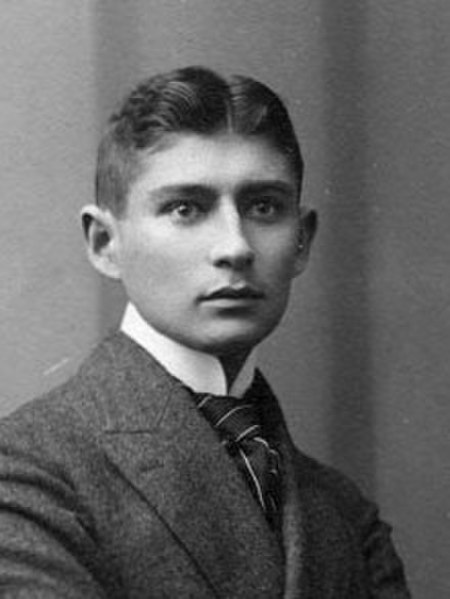 Franz Kafka was born in July of 1883 to a Middle class, German-speaking Jewish family in Prague. (The country was not yet considered The Czech Republic at this time but was considered Bohemia, part of Austria-Hungary.) He would be the eldest of two other brothers and three sisters, unfortunately both brothers died in their infancy. His father and mother made their living running a store that sold trinkets and accessories and were reasonably successful at it. Franz did not get on well with his father, though he seems to hold a begrudging respect for him, and his relationship would later play as a major influence in his writing. His father is often described as loud, overbearing, demanding, and authoritarian. Despite this setback, Franz was well educated in the classics in grade school and in Law in college. Later in his working life, Franz was generally described as an astute and motivated worker, though he often claimed that he hated his job as an insurance lawyer, and took the opportunity to write in his spare time. In 1917 Franz contracted tuberculosis but continued to write as well as date women who found his manner charming. During his decreasing health he had to rely on his family, mainly his sisters, for support which was humiliating to him. In 1924 he died of his sickness and starvation because his illness made it impossible to swallow and there were no medical solutions for that at the time. Before his death he requested that all of his works and papers be burned unread, but his friend actually dedicated his life to having them published. During Kafka's living years he was not successful as a writer outside of publishing a few short stories, the lions share of his work did not see the light of day until after his death. On a sad note, 20 years after his death all three of his sisters would fall prey the the Nazi war-machine and would each perish in concentration camps. Many of Kafka's letters and papers retained by a former love interest would also be seized by the gestapo at this time (these have never been recovered).
Wednesday, October 12, 2011
The un-prodigious reader returns!
Hello and Hello! I am back! Sorry about my long absence, my summer job duties are stressful as well as mentally and physically draining. I think this proves beyond any shadow of a doubt that I could never manage a true book club. But the cool weather is relaxing and uplifting to my spirits and I am ready to commit to several more books. To be fair to anyone who has picked up any of the book club titles in advance or any passers-by I will stick to the prearranged list (albeit a few months off schedule). I am a fast reader and I plan to play catch up until Christmas. Lets see if I can do it......
Its just something about the lighter workload of the Fall combined with the cool weather that encourages me to read classic lit. Perhaps it is because so many classics are set in cool or stormy weather and the cool weather helps me get into the story. That actually raises an interesting question, why is it that so many classics are in set snowy or stormy weather, foggy nights etc.? Beowulf and Odysseus were cast on stormy seas; Frankenstein traversed snowy mountains, foggy lakes, and frozen oceans. I think one answer is that most of the older classics are of European origin which tends to have a wetter climate. Another, I would surmise, is that many are tragedies and a sunny spring day rarely sets the mood for sorrow and despair. A theory I have regarding this is that active weather denotes action in the readers mind. It says something is happening in that world and helps us join into the situation. It is more interesting to imagine a man walking through a drizzle than a calm partly cloudy day. A storm can be even better, hence the over-used "dark and stormy night." In this months catch up book the Tempest, such a storm sets our entire story in motion.
Here is a brief recap of the tale. Prospero (the Duke of Milan) and his infant daughter Miranda were exiled and cast out to sea by Prospero's power-hungry brother Antonio with help from Alonso, the King of Naples. Prospero and Miranda find shelter on an island and make their home there. Many years later, when Miranda reaches the age of marriage (15 in this case... it was the 1600's after all) and Prospero is at the height of his magical power he conjures up a storm, the titular tempest, and washes his enemies (who happen to be on a return voyage from Africa) to his shore. There he begins his strategy to make his enemies suffer and restore himself and his daughter to rights. His strategies ultimately result in his daughter becoming engaged to Ferdinand, the kings son, and the other parties being separated and humiliated but ultimately forgiven.
My feelings on The Tempest:
With this being my first attempt at Shakespeare since 1992, I found that it was fairly difficult at first. Even with the left page reading guide, I feel like I missed much due to the cryptic language. Still, after reading the book cover to cover, I felt lost on some of the finer points of the plot. By the end of the reading, I will say I was much more used to language and the reading went more smoothly but by that time I felt like small points of the story was lost. Sadly, for this reason, I cannot be as analytical as I have been with past titles. I can say this however: After reading some extended information on the story, much of the analysis tends to be whether Shakespeare derived certain lines from other sources (it seems he did) and whether the story was a rehash of another popular play of the time (which also looks likely). Very little analysis seems to be on any inherent meaning or philosophy of the text as whole. For instance, one argument is that The Tempest was Shakespeare's farewell piece because he never composed another play on his own afterwards and some lines are thought to hint at this. I can actually see why little focus is spent on the story itself. Despite the challenging reading, the story is quite simple. It was a piece created for stage with a bit of show for the "magical" portions and a bit of comedy thrown in to boot, all wrapped up in a happy ending with a bit of audience participation. Like Beowulf, which I certainly enjoyed more, I feel I need to re-read this to gain a better feel for the text. However, I will be glad to put some distance between me and the works of Shakespeare for the time being.
Next: I will be discussing Franz Kafka's Metamorphosis.
Joe
Its just something about the lighter workload of the Fall combined with the cool weather that encourages me to read classic lit. Perhaps it is because so many classics are set in cool or stormy weather and the cool weather helps me get into the story. That actually raises an interesting question, why is it that so many classics are in set snowy or stormy weather, foggy nights etc.? Beowulf and Odysseus were cast on stormy seas; Frankenstein traversed snowy mountains, foggy lakes, and frozen oceans. I think one answer is that most of the older classics are of European origin which tends to have a wetter climate. Another, I would surmise, is that many are tragedies and a sunny spring day rarely sets the mood for sorrow and despair. A theory I have regarding this is that active weather denotes action in the readers mind. It says something is happening in that world and helps us join into the situation. It is more interesting to imagine a man walking through a drizzle than a calm partly cloudy day. A storm can be even better, hence the over-used "dark and stormy night." In this months catch up book the Tempest, such a storm sets our entire story in motion.
Here is a brief recap of the tale. Prospero (the Duke of Milan) and his infant daughter Miranda were exiled and cast out to sea by Prospero's power-hungry brother Antonio with help from Alonso, the King of Naples. Prospero and Miranda find shelter on an island and make their home there. Many years later, when Miranda reaches the age of marriage (15 in this case... it was the 1600's after all) and Prospero is at the height of his magical power he conjures up a storm, the titular tempest, and washes his enemies (who happen to be on a return voyage from Africa) to his shore. There he begins his strategy to make his enemies suffer and restore himself and his daughter to rights. His strategies ultimately result in his daughter becoming engaged to Ferdinand, the kings son, and the other parties being separated and humiliated but ultimately forgiven.
My feelings on The Tempest:
With this being my first attempt at Shakespeare since 1992, I found that it was fairly difficult at first. Even with the left page reading guide, I feel like I missed much due to the cryptic language. Still, after reading the book cover to cover, I felt lost on some of the finer points of the plot. By the end of the reading, I will say I was much more used to language and the reading went more smoothly but by that time I felt like small points of the story was lost. Sadly, for this reason, I cannot be as analytical as I have been with past titles. I can say this however: After reading some extended information on the story, much of the analysis tends to be whether Shakespeare derived certain lines from other sources (it seems he did) and whether the story was a rehash of another popular play of the time (which also looks likely). Very little analysis seems to be on any inherent meaning or philosophy of the text as whole. For instance, one argument is that The Tempest was Shakespeare's farewell piece because he never composed another play on his own afterwards and some lines are thought to hint at this. I can actually see why little focus is spent on the story itself. Despite the challenging reading, the story is quite simple. It was a piece created for stage with a bit of show for the "magical" portions and a bit of comedy thrown in to boot, all wrapped up in a happy ending with a bit of audience participation. Like Beowulf, which I certainly enjoyed more, I feel I need to re-read this to gain a better feel for the text. However, I will be glad to put some distance between me and the works of Shakespeare for the time being.
Next: I will be discussing Franz Kafka's Metamorphosis.
Joe
Tuesday, August 9, 2011
Where have I been?
I think it has been two months to the day since my last post and I would apologize if I had any sort of following, but seeing as this book club was sort of a self motivating pressure for me to read the classics, I will keep my apology to myself fairly short. Sorry, me. That's pretty short right? What have I been doing the past 2 months, you may be wondering? Well, about 50% into the Tempest I got busy with various life things but mostly I had a bad case of classic literature burn out. I think a lot of it has to do with the miserably hot weather. Each night, which is my traditional reading time I would look at the Tempest and think "That is the absolute last thing in the world I want to look at for any reason whatsoever." I found that I was avoiding reading in general just to avoid reading THAT. Was it that bad? Honestly, no. I thought it was an alright read, It just seemed like work after a while. After about a few weeks of avoiding that, I decided that I should at least read something I enjoy. So, I have spent the last month or so, knocking out some fun fantasy novels just to keep myself happy and entertained.
Now, the good news is that my interest in literature has not passed on, I still have the drive to read them. But I will put them on hold until sometime in the Fall when I will either pick up exactly where I left off, or I will rebuild the book list to suit my mood. It should not be too far off actually, I caught myself eyeballing my classics a few days ago ( Hence this blog posting ). So, until then, I will continue with my mental vacation filled with High fantasy, Sci-fi, and other nerdy goodness until may brain is ready to tackle another wave of classics.
Thanks all!
joe
Now, the good news is that my interest in literature has not passed on, I still have the drive to read them. But I will put them on hold until sometime in the Fall when I will either pick up exactly where I left off, or I will rebuild the book list to suit my mood. It should not be too far off actually, I caught myself eyeballing my classics a few days ago ( Hence this blog posting ). So, until then, I will continue with my mental vacation filled with High fantasy, Sci-fi, and other nerdy goodness until may brain is ready to tackle another wave of classics.
Thanks all!
joe
Thursday, June 9, 2011
June's Book: The Tempest!
Greetings everyone! I am pleased to announce (with some slight apprehension) that the featured book for June will be William Shakespeare's The Tempest. My apprehension comes from the grade-school fear of anything relating to Shakespeare and his twisted turns of phrase and part way into the book I have discovered that my fears are not entirely unfounded. Yes, indeed, it is truly a challenging read. It took me a while to adapt to the prose but I like a challenge. If you have difficulty with the prose, as the editor of this edition remarks, you should not feel alone; Shakespeare was not well understood in his own time. Not only was he known for inventing words, many of which are still in use like "assassin" (and many which aren't like "congree" (to agree with one's self)) but he also stretched the meaning of common words to their limits. For this reason, I highly recommend picking up the Barnes and Noble edition of The Tempest. Barnes and Noble has issued very nice editions of each of Shakespeare's plays in paperback which are heavily annotated for both meaning and context for any word or phrase that may have an exotic or archaic definition. Sometimes it will translate an entire paragraph, if necessary, and I have found it to be indispensable. It also includes multiple forewords and afterwords from scholars on history and context. Here is the information:
The Tempest by William Shakespeare; Editor: Gordon McMullan, ISBN 978-1-4114-0076-4 $7.95 USA
As always, I like to give a brief introduction about the author and novel (in this case a play) but it feels strange introducing an author that is so iconic to the western world. In fact, his plays are performed more often than any other playwright in existence. We learn about Shakespeare in middle school and even if few can remember what his plays were about, we certainly know who he is. This, in a way, is very interesting because even scholars know very little about his life outside his works. You could say that nobody knows him. We know that he was born sometime around 1564 in the town of Stratford-upon-Avon to reasonably well off parents. We know that at the age of 18 he married the 26 year old Anne Hathaway who bore him three children. Sometime in his twenties he became part owner of a playing company which was very successful and would eventually be known as The King's Men. During this time he produced the majority of his known work which amounts to 38 plays, over 150 sonnets, and many poems. After a long career on and off the stage he died in April of 1616. Unfortunately, very little is recorded of his life outside the stage and much of what we do know is second hand information. In any case, in his lifetime he profoundly affected the course of today's entertainment and the English Language itself.
The Tempest was written in the final days of Shakespeare's writing career and is considered a tragicomedy, or more simply, a romance. In the case of older literature the word comedy often references the presence of a happy ending more so than any real humor (although humor can certainly be found in his plays). The Tempest tells the tale of a Magus (Prosepero) and his daughter sent to their deaths at sea by his power hungry brother. Prospero and his daughter survive on an island and, 12 years later, are afforded the opportunity to settle the score and put things right again. Please enjoy the tale as The Tempest is considered one of Shakespeare's greatest works!
Thanks! Joe
The Tempest by William Shakespeare; Editor: Gordon McMullan, ISBN 978-1-4114-0076-4 $7.95 USA
As always, I like to give a brief introduction about the author and novel (in this case a play) but it feels strange introducing an author that is so iconic to the western world. In fact, his plays are performed more often than any other playwright in existence. We learn about Shakespeare in middle school and even if few can remember what his plays were about, we certainly know who he is. This, in a way, is very interesting because even scholars know very little about his life outside his works. You could say that nobody knows him. We know that he was born sometime around 1564 in the town of Stratford-upon-Avon to reasonably well off parents. We know that at the age of 18 he married the 26 year old Anne Hathaway who bore him three children. Sometime in his twenties he became part owner of a playing company which was very successful and would eventually be known as The King's Men. During this time he produced the majority of his known work which amounts to 38 plays, over 150 sonnets, and many poems. After a long career on and off the stage he died in April of 1616. Unfortunately, very little is recorded of his life outside the stage and much of what we do know is second hand information. In any case, in his lifetime he profoundly affected the course of today's entertainment and the English Language itself.
The Tempest was written in the final days of Shakespeare's writing career and is considered a tragicomedy, or more simply, a romance. In the case of older literature the word comedy often references the presence of a happy ending more so than any real humor (although humor can certainly be found in his plays). The Tempest tells the tale of a Magus (Prosepero) and his daughter sent to their deaths at sea by his power hungry brother. Prospero and his daughter survive on an island and, 12 years later, are afforded the opportunity to settle the score and put things right again. Please enjoy the tale as The Tempest is considered one of Shakespeare's greatest works!
Thanks! Joe
Tuesday, May 31, 2011
Thoughts on War of the Worlds
Sometimes with a short story or novella such as this, one can find volumes of interesting material to discuss. And after having recently read other magnificent works by H.G. Wells such as The Invisible Man, The Island of Doctor Moreau and The Time Machine, I had high hopes for War of the Worlds. Sadly, War of the Worlds was less than stellar. I think H.G. Wells may have put it best when, two years after the famous radio debacle, he thanked Orson Wells for increasing sales to one of his "more obscure" titles. Perhaps he too felt it was a weak entry. I am not trying to say that it is a terrible story by any means. It was well received by both readers and critics when originally published in 1897 and 1898 and has heavily influenced science fiction ever since. I just think that, compared to his other works, it feels much less defined. The main thing that irritates me is how the main character is handled. The "main character" is never named but Wells goes so far as to give him a job, a wife and a brother. His actions and reactions are dry and robotic and he seems more faceless than the enemy he is fleeing. The story, itself, chugs along like a broken train, in fits and stops. Halfway through his escape we are told of his brother's journey for many pages and the transition between the two tales is so poor that sometimes I was unsure of which character I was reading about. Hmmm, perhaps character names would've come in handy here? I am sure this is a symptom of the serialized form of publication but it strongly reeks of being haphazardly extended for the readers.
Now I guess it's only fair that I also explain what was good about it. I am, to begin with, a big fan of old horror and sci-fi stories. This was written in the journalistic style, which is a way of lending the story a feeling of reality and was often employed by some of my favorite horror writers like Poe and Lovecraft. So, in other words, I liked the format and it had a feeling of familiarity. I also like that Wells was not shy about introducing a little violence and gore into the mix. It must have been shocking to read about one's fellow countrymen being reduced to blackened and charred corpses or being drained of blood by hooting aliens. Even themain character trying to sate his own starvation by sucking on the dry bones of unidentifiable animal skeletons adds another level of horror. But if the main character was not well developed, the aliens were. I cant picture the character we were reading about but the aliens and their mysterious equipment are very clearly defined. Wells degree in zoology comes into play many times as he discusses how the aliens reproduce, how they eat, or how the strange red weed spreads over the countryside. But, most of all, I think the concept of how the aliens react to humans is what gained the book its popularity. I thinks a human would show more sympathy in killing a nest of rats than the aliens did for humanity. They treat the citizens of England much like we would a patch of weeds. There is no attempt to communicate, no torture, nothing to even regard humans as sentient creatures. It is a beautiful and horrifying concept.
As a final note. If you look closely, you can detect some of Well's social views coming through. He throws rich and poor in the same horrible situation. He even has a horse trample a rich man trying to clamber in the mud for his spilled coins. He shows the weak position of the church and the clergy on multiple occasions. I feel that Wells did not have a particularly high opinion of his own countrymen in the way that all of their best efforts result in foolishness or disaster and most of the other characters are clownish in behavior.
Well, I hope all of you enjoyed the short story (in some manner) and I will be back soon to introduce The Tempest. Thanks everyone!
Joe
Now I guess it's only fair that I also explain what was good about it. I am, to begin with, a big fan of old horror and sci-fi stories. This was written in the journalistic style, which is a way of lending the story a feeling of reality and was often employed by some of my favorite horror writers like Poe and Lovecraft. So, in other words, I liked the format and it had a feeling of familiarity. I also like that Wells was not shy about introducing a little violence and gore into the mix. It must have been shocking to read about one's fellow countrymen being reduced to blackened and charred corpses or being drained of blood by hooting aliens. Even themain character trying to sate his own starvation by sucking on the dry bones of unidentifiable animal skeletons adds another level of horror. But if the main character was not well developed, the aliens were. I cant picture the character we were reading about but the aliens and their mysterious equipment are very clearly defined. Wells degree in zoology comes into play many times as he discusses how the aliens reproduce, how they eat, or how the strange red weed spreads over the countryside. But, most of all, I think the concept of how the aliens react to humans is what gained the book its popularity. I thinks a human would show more sympathy in killing a nest of rats than the aliens did for humanity. They treat the citizens of England much like we would a patch of weeds. There is no attempt to communicate, no torture, nothing to even regard humans as sentient creatures. It is a beautiful and horrifying concept.
As a final note. If you look closely, you can detect some of Well's social views coming through. He throws rich and poor in the same horrible situation. He even has a horse trample a rich man trying to clamber in the mud for his spilled coins. He shows the weak position of the church and the clergy on multiple occasions. I feel that Wells did not have a particularly high opinion of his own countrymen in the way that all of their best efforts result in foolishness or disaster and most of the other characters are clownish in behavior.
Well, I hope all of you enjoyed the short story (in some manner) and I will be back soon to introduce The Tempest. Thanks everyone!
Joe
Wednesday, May 25, 2011
May's Selection: H.G.Wells War of the Worlds
Hello everyone and my sincerest apologies for the delay. May has been quite a busy month for me and I have had little time to commit to reading or writing. Thankfully, I have had a short respite from my duties and now have a little time to announce this months book (albeit a bit late...) . I'm sure it seems incredibly swell of me to post the book information one week from the end of the month, but maybe two people are currently following this book-list so I won't fret over it. For you others out there who are also saddled with busy work or social lives I am glad to inform you that this months choice, H.G. Wells' War of the Worlds, tops out at a mere 130 or so pages. This should make for a light, few nights read compared to our last few endeavors. For those of you who have not picked up a copy as yet, any edition will do. We do not have to deal with translations or multiple versions in this case. I, myself, acquired from Barnes and Nobles a nice gilded and leather-bound volume of H.G. Wells seven novels but you do not need to go that far with it. Anyone should be able to find a super-cheap used copy from Amazon.com, or a local used-book seller. Those who really want to save cash can probably find free online versions (those who have Kindles also have access to free pre-1920 books; I always support the buying of books but I know the economy is tough right now.
Herbert George Wells was an English author born in 1866 into a family of meager income. His father was an unsuccessful businessman who would jump from one failed enterprise to another while his mother remained at a fixed position as a live-in maid. This would eventually lead to his parents living separately and him having to seek apprenticeships. H.G. Wells would, in his early adult life, struggle to find teaching positions, often temporary, and sometimes could not keep himself well-fed or gainfully employed. Wells, socially speaking, was a bit of a womanizer having been married twice while still engaging in multiple affairs with a myriad of women including an early activist for birth control and a feminist writer. Philosophically, Wells was a pacifist as well as a socialist extremist whose views were so divergent they eventually got him expelled from the socialist Fabian Society. Conversely, he was also a Social Darwinist and supported the now-controversial idea of eugenics (preventing "undesirable" traits from continuing in the human gene-pool). Despite his outspoken political and philosophical views Wells is still considered one of the great thinkers of his time. In addition to his "Social Science Fiction" novels he also published several scientific journals and articles and accurately predicted some of the progress of the twenty-first century.
War of the Worlds tells the story of one man's observations of an alien invasion on the terribly unprepared (who would be?) London suburb of Woking. Attentive readers should be able to pick up on some of H.G. Wells' typical social commentary in this novella.
Herbert George Wells was an English author born in 1866 into a family of meager income. His father was an unsuccessful businessman who would jump from one failed enterprise to another while his mother remained at a fixed position as a live-in maid. This would eventually lead to his parents living separately and him having to seek apprenticeships. H.G. Wells would, in his early adult life, struggle to find teaching positions, often temporary, and sometimes could not keep himself well-fed or gainfully employed. Wells, socially speaking, was a bit of a womanizer having been married twice while still engaging in multiple affairs with a myriad of women including an early activist for birth control and a feminist writer. Philosophically, Wells was a pacifist as well as a socialist extremist whose views were so divergent they eventually got him expelled from the socialist Fabian Society. Conversely, he was also a Social Darwinist and supported the now-controversial idea of eugenics (preventing "undesirable" traits from continuing in the human gene-pool). Despite his outspoken political and philosophical views Wells is still considered one of the great thinkers of his time. In addition to his "Social Science Fiction" novels he also published several scientific journals and articles and accurately predicted some of the progress of the twenty-first century.
War of the Worlds tells the story of one man's observations of an alien invasion on the terribly unprepared (who would be?) London suburb of Woking. Attentive readers should be able to pick up on some of H.G. Wells' typical social commentary in this novella.
Saturday, April 23, 2011
Thoughts on Beowulf
Much like my experience with Frankenstein, my only exposure to Beowulf was the animated film "starring" Angelina Jolie. I never had to read it as part of my literature curriculum like most people seem to have had to. As I mentioned in prior ramblings, I probably wouldn't have enjoyed it anyway at that age. That being said, I have fairly mixed feelings about it now. It certainly was a bit richer than some of the other translations I perused prior to buying this one, and in general, I thought the poem was interesting and moderately enjoyable, but I feel this is one of those works that require multiple readings to fully appreciate.
Allow me to, first, describe what I liked about it. It had an air of familiarity with its heavy formalities involving guests. Beowulf arrives at the land of the Danes and tales are told and gifts are exchanged for several pages before he announces why he is there and then the compliments and gift giving begin again. Readers may find this similar to the Greek courtesies toward guests and strangers found in the Odyssey where food and comfort is offered first and foremost, even before names are exchanged. Interestingly, despite this observation, this society is less polite than most. This is a warrior based culture and Unferth, the King's aide, and Beowulf are not afraid to trade insults and Beowulf's only speeches are boasts of what he has done and will do.
I also liked that this has the feeling of an Anglo-Saxon "tall-tale." Beowulf is the warrior version of Paul Bunyan able to do deeds no other man can accomplish. I feel this is different than the Greek tales of Herakles (Hercules) which seems more tied to the gods and the Greek religion than this. This has an interesting feeling of being grounded in reality despite the the monsters and dragons. I almost feel that these are make believe tales of a man that once existed. Reading this almost makes me wonder if there was a beast called Grendel. He kills the beast by removing its arm and it escapes and dies on its own, that is a weird way to tell of a triumph. That is far different that the standard tale of lopping off its head or sending a spear through its heart with a decisive win. That is why it has the strange feeling of being real to me, the telling is too unusual. The lineages of both tribes also lend it a flavor of reality with the names of major kings going back several generations.
Another thing that I liked was the particular cadence of the prose:
"So Grendel ruled in defiance of right,
one against all, until the greatest house
in the world stood empty, a deserted wallstead"
This style of cadence almost gives it the feel of a harmonic chant. I can imagine this being recited by a bard in a gathering of Anglo-Saxons centuries ago. If you pay attention to to the wording you will also pick up on the alliterative style of poetry. "...their wassail was over, they wept to heaven / and mourned under morning. Their mighty prince." You should keep in mind that the translator,Seamus Heaney, was trying to preserve the feel of the original poem and chose his words to use carefully to mimic the same alliteration.
One of the things I did not like about the poem was that Beowulf dies before the end of the poem and we have to spend many pages recalling the feats of a previous king and his heirs and why the Geats may be attacked and then the poem jumps back to Beowulf's last requests being fulfilled. This may seem like a minor issue but the reader has to push through a cast of new characters performing deeds in the past that has little bearing on the story. This actually occurs more than once where we read a story within a story, the feats of previous heroes and kings as well as Beowulf's past deeds. We also have to hear Beowulf recap how he killed the mother of Grendel right after he completes the task.
Perhaps one day after I have explored all of the other works that have attracted my attention, I may see a need to further explore this epic one day and maybe pick it apart in a more scholarly fashion (though doubtfully) but in the meantime there are too many books and so few evenings to read them in!
Allow me to, first, describe what I liked about it. It had an air of familiarity with its heavy formalities involving guests. Beowulf arrives at the land of the Danes and tales are told and gifts are exchanged for several pages before he announces why he is there and then the compliments and gift giving begin again. Readers may find this similar to the Greek courtesies toward guests and strangers found in the Odyssey where food and comfort is offered first and foremost, even before names are exchanged. Interestingly, despite this observation, this society is less polite than most. This is a warrior based culture and Unferth, the King's aide, and Beowulf are not afraid to trade insults and Beowulf's only speeches are boasts of what he has done and will do.
I also liked that this has the feeling of an Anglo-Saxon "tall-tale." Beowulf is the warrior version of Paul Bunyan able to do deeds no other man can accomplish. I feel this is different than the Greek tales of Herakles (Hercules) which seems more tied to the gods and the Greek religion than this. This has an interesting feeling of being grounded in reality despite the the monsters and dragons. I almost feel that these are make believe tales of a man that once existed. Reading this almost makes me wonder if there was a beast called Grendel. He kills the beast by removing its arm and it escapes and dies on its own, that is a weird way to tell of a triumph. That is far different that the standard tale of lopping off its head or sending a spear through its heart with a decisive win. That is why it has the strange feeling of being real to me, the telling is too unusual. The lineages of both tribes also lend it a flavor of reality with the names of major kings going back several generations.
Another thing that I liked was the particular cadence of the prose:
"So Grendel ruled in defiance of right,
one against all, until the greatest house
in the world stood empty, a deserted wallstead"
This style of cadence almost gives it the feel of a harmonic chant. I can imagine this being recited by a bard in a gathering of Anglo-Saxons centuries ago. If you pay attention to to the wording you will also pick up on the alliterative style of poetry. "...their wassail was over, they wept to heaven / and mourned under morning. Their mighty prince." You should keep in mind that the translator,Seamus Heaney, was trying to preserve the feel of the original poem and chose his words to use carefully to mimic the same alliteration.
One of the things I did not like about the poem was that Beowulf dies before the end of the poem and we have to spend many pages recalling the feats of a previous king and his heirs and why the Geats may be attacked and then the poem jumps back to Beowulf's last requests being fulfilled. This may seem like a minor issue but the reader has to push through a cast of new characters performing deeds in the past that has little bearing on the story. This actually occurs more than once where we read a story within a story, the feats of previous heroes and kings as well as Beowulf's past deeds. We also have to hear Beowulf recap how he killed the mother of Grendel right after he completes the task.
Perhaps one day after I have explored all of the other works that have attracted my attention, I may see a need to further explore this epic one day and maybe pick it apart in a more scholarly fashion (though doubtfully) but in the meantime there are too many books and so few evenings to read them in!
Saturday, April 9, 2011
April Selection: Beowulf - author unknown
This month we will be reading Beowulf! I have selected Seamus Heaney's New Verse Translation: Bilingual Edition for its ease of use and nice introduction. The pages are set up with the Old English script on the left page on the new translation on the right. We won't be using the Old English version, of course, but its there for those who are curious. My favorite thing about this edition is that a synopsis of events are notated in the margins making it easy to reference later and it helps clarify things for those who may find the poetry difficult. However, readers should not be daunted by that, I have discovered the text to very easy to read and understand so far. I doubt that anyone will experience any difficulty at all.
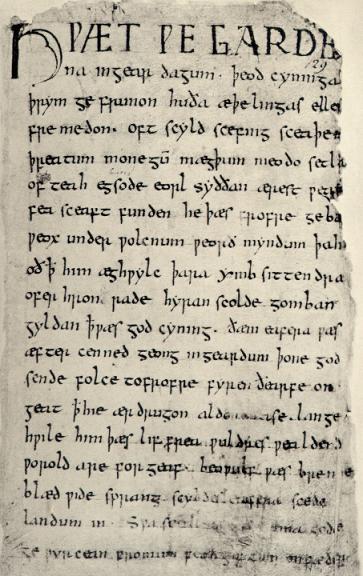
What is shown here (insert) is part of the only existing remnant of any Beowulf manuscript, and dates from the 8th to 11th century A.D. It barely survived a fire in 1731 and remained in its burnt binding until it was rebound in the mid 19th century at the British museum. Without this, it is doubtful any trace of the poem would have ever become known otherwise. Now, Beowulf, from this one manuscript, has become a standard in English literature, a source for linguistic studies in Old English, and a reference for scholars of Scandinavian tribes. Aside from being a great sample of literature from the dark ages, very little is known about the poem or the poet. We, for example, don't know who wrote it or when it was written. We don't know if it is the work of a single man or the accumulation of an oral tradition like the Gilgamesh Epic (or the Bible!). What we do know about it, we have extracted from the poem itself, such as what era and region the English used is from and other historical references found within such as the tribes of the Geats and Swedes.
While reading you may want to consider:
How does the book define a good man or hero? How does it differ from the Greek tradition of a hero in The Odyssey?
The book is written by a (most likely) Christian Anglo-Saxon (Early English) about Scandinavian Pagan heroes, this is considered an interesting irony by scholars. What is your impression?
Based on ideas and excerpts in the poem do you feel that the writer is a Christian or a pagan?
 |
| Original Manuscript |
While reading you may want to consider:
How does the book define a good man or hero? How does it differ from the Greek tradition of a hero in The Odyssey?
The book is written by a (most likely) Christian Anglo-Saxon (Early English) about Scandinavian Pagan heroes, this is considered an interesting irony by scholars. What is your impression?
Based on ideas and excerpts in the poem do you feel that the writer is a Christian or a pagan?
Monday, April 4, 2011
Impressions on Frankenstein
Hey folks! I hope everyone enjoyed Frankenstein as much as I did. Looking back at my introduction on Frankenstein, I realize that I failed to mention that I had made an attempt to to read it about five years ago. I attempted at a time when I was seeking out gothic fiction from the same era (or earlier) or even similar gothic pulp fiction from the late 1800's (Poe) to the early 1900's (Lovecraft) onward. At the time I was seeking cobweb laden castles riddled with trap-doors, secret passages, and the faint stirrings of ghosts. Approaching Frankenstein at that time was a mistake; there were no castles, "the monster" was all too human, and Frankenstein was a miserable crybaby. Needless to say, I got bored with it halfway and read The Monk by Matthew Lewis instead (and loved it, by the way!) Now, I must admit that I am glad that I approached Frankenstein once again. This time I enjoyed it thoroughly.
Is this a gothic novel? Although it lacks the aforementioned castles and cobwebs as well as other gothic archetypes like sinister authority figures or ancestral curses, it is indeed a gothic novel. Try to remember the misty mountains the monster resides in or the fog shrouded lake where Frankenstein disposes of his abandoned female creation and you will see the similarities. But, I believe that it is Shelley's deviation from the standards of gothic fiction that helped cement her book as a classic that is still read today.
I mentioned earlier the alternate title "The Modern Prometheus" for purposes of discussion. As I doubt there will be any actual discussion, I will touch on it lightly for any readers who happen by. To sum up the Greek myth of Prometheus; humankind tricked Zeus into accepting displeasing offerings as sacrifices so Zeus hid the mystery of fire from humanity. Prometheus stole it back and gave it to mankind. Zeus punished him by having him chained to a rock and having an eagle eat out his liver daily only to have it grow back overnight. In comparison to the novel Frankenstein we can see that it is the concept of forbidden knowledge and the punishment that goes with it that Shelley is trying to address. Prometheus loses his liver each day, Frankenstein loses his friends, family, wife, wealth, and life for the forbidden knowledge of the mystery of life.
For those who are curious about the differences between the film and book, I will mention some of the main ones here. First, just to let you know, there are no similarities other than a few names and locations. The monster is large in both works but in the novel he is also swift and intelligent as well as devious and emotional, not the lumbering moaning creature portrayed by Karloff. In the film, Frankenstein has a castle where he derives life from the power of lightning. In the book he creates the monster in his apartment but can't remember how. He also does not see the creature for months after he made it because it escaped immediately. As you can see the differences are quite stark and can go on in this vein for several paragraphs.
The theme of abortion also permeates the novel. I personally feel this is almost too obvious (and weak, at that) to be worthy of discussion but I will bring it up briefly because it is commonly discussed in conjunction with this work. Frankenstein's creation can be considered an "abortion" in the way that created it and then dismissed it and even tries to kill it. His second creation is a closer abortion in the way that he gathers the parts and disposes of them before it was "born". I am not a fan of this applied metaphor because it breaks down under scrutiny, Frankenstein's creation more closely parallels "child abandonment" than anything else. If you put it to closer scrutiny, the creature ran away when it came to life so really the theme is closer to a "wayward son" premise. Frankenstein was not disgusted with it as he built it (though he was delirious) so who is to say he did not have the capacity to teach it and raise it?
Is this a gothic novel? Although it lacks the aforementioned castles and cobwebs as well as other gothic archetypes like sinister authority figures or ancestral curses, it is indeed a gothic novel. Try to remember the misty mountains the monster resides in or the fog shrouded lake where Frankenstein disposes of his abandoned female creation and you will see the similarities. But, I believe that it is Shelley's deviation from the standards of gothic fiction that helped cement her book as a classic that is still read today.
I mentioned earlier the alternate title "The Modern Prometheus" for purposes of discussion. As I doubt there will be any actual discussion, I will touch on it lightly for any readers who happen by. To sum up the Greek myth of Prometheus; humankind tricked Zeus into accepting displeasing offerings as sacrifices so Zeus hid the mystery of fire from humanity. Prometheus stole it back and gave it to mankind. Zeus punished him by having him chained to a rock and having an eagle eat out his liver daily only to have it grow back overnight. In comparison to the novel Frankenstein we can see that it is the concept of forbidden knowledge and the punishment that goes with it that Shelley is trying to address. Prometheus loses his liver each day, Frankenstein loses his friends, family, wife, wealth, and life for the forbidden knowledge of the mystery of life.
For those who are curious about the differences between the film and book, I will mention some of the main ones here. First, just to let you know, there are no similarities other than a few names and locations. The monster is large in both works but in the novel he is also swift and intelligent as well as devious and emotional, not the lumbering moaning creature portrayed by Karloff. In the film, Frankenstein has a castle where he derives life from the power of lightning. In the book he creates the monster in his apartment but can't remember how. He also does not see the creature for months after he made it because it escaped immediately. As you can see the differences are quite stark and can go on in this vein for several paragraphs.
The theme of abortion also permeates the novel. I personally feel this is almost too obvious (and weak, at that) to be worthy of discussion but I will bring it up briefly because it is commonly discussed in conjunction with this work. Frankenstein's creation can be considered an "abortion" in the way that created it and then dismissed it and even tries to kill it. His second creation is a closer abortion in the way that he gathers the parts and disposes of them before it was "born". I am not a fan of this applied metaphor because it breaks down under scrutiny, Frankenstein's creation more closely parallels "child abandonment" than anything else. If you put it to closer scrutiny, the creature ran away when it came to life so really the theme is closer to a "wayward son" premise. Frankenstein was not disgusted with it as he built it (though he was delirious) so who is to say he did not have the capacity to teach it and raise it?
Wednesday, March 9, 2011
March selection: Mary Shelly's Frankenstein!
Frankenstein by Mary Wollstonecraft Shelley
About this month's selection: There are several versions of Frankenstein available but the differences are generally minor with a few word or sentence changes or alterations on chapter breaks. By happenstance I grabbed an interesting version that has all of the changes and additions that her husband, Percy Bysshe Shelley, made written in italics. It also has, as an addendum, her original version entirely from her own hand. Readers are not required to get this edition as any version will do. [ For interested parties the ISBN of mine is 978-0-307-47442-1]. I selected this book, not only because I (barely) started a few years ago and never finished it (a different copy), but also because this is a nice easy dip into the world of classic Gothic fiction. Gothic fiction happens to be one of my favorite genres but I think some of the more definitive Gothic texts may be too dry for first timers. Some examples are The Castle of Otranto, Carmilla, and The Mysteries of Udolpho. Carmilla is such a great story that I may have to add it in for October, but I may just work in something that I have never read before.
About the book: Most people know or have heard that the book Frankenstein and the Hollywood representation of Frankenstein are absolutely nothing alike; not just in appearance but in place, manner, story, and character. Essentially every aspect of the film diverged completely from the book. Now you have the opportunity to discover a different scientist and monster than you ever would have guessed. Can you envision a thoughtful and embarrassed Dr. Frankenstein; or a monster that can speak and reason?
The origin of the novel is an interesting story by itself. In May of 1816, Mary Godwin along with Percy Shelly (her future husband), John Polidori, and the poet Lord Byron were staying at a villa rented by Byron at Lake Geneva in Switzerland. One evening, they were reading German ghost stories and it was proposed as a challenge that each compose a short horror story of their own design. Lord Byron created a "fragment" of a vampire story and Polidori built upon that to create The Vampyre. Of each story, Mary Godwin's was to be the largest and most memorable. The idea for her story was conceived one day "in a waking dream."
"I saw the pale student of unhallowed arts kneeling beside the thing he had put together. I saw the hideous phantasm of a man stretched out, and then, on the working of some powerful engine, show signs of life, and stir with an uneasy, half vital motion. Frightful must it be; for supremely frightful would be the effect of any human endeavour to mock the stupendous mechanism of the Creator of the world."
Percy Shelley did not create a story but he was very influential on the formation of Frankenstein helping to edit, encouraging Mary to develop it into a full length novel, and ultimately, adding 5000 words of his own. Two years and many revisions later, Frankenstein became the novel as we know it today. Although it was regarded unfavorably by critics, it achieved a popular success with general readers. This month, let's explore what attracted their favor!
Things to consider while reading:
Frankenstein actually has a subtitle called Frankenstein, or, The Modern Prometheus. How does this story tie in with the myth of Prometheus?
What elements of the book classify it as Gothic literature? Which does it lack?
If you have seen it, do you think the film is more Gothic than the book?
How can the scientist and the creature both be classified as "monsters"? Which of them is the least reasonable?
Some have tied this book to themes of abortion, do you find similarities?
About this month's selection: There are several versions of Frankenstein available but the differences are generally minor with a few word or sentence changes or alterations on chapter breaks. By happenstance I grabbed an interesting version that has all of the changes and additions that her husband, Percy Bysshe Shelley, made written in italics. It also has, as an addendum, her original version entirely from her own hand. Readers are not required to get this edition as any version will do. [ For interested parties the ISBN of mine is 978-0-307-47442-1]. I selected this book, not only because I (barely) started a few years ago and never finished it (a different copy), but also because this is a nice easy dip into the world of classic Gothic fiction. Gothic fiction happens to be one of my favorite genres but I think some of the more definitive Gothic texts may be too dry for first timers. Some examples are The Castle of Otranto, Carmilla, and The Mysteries of Udolpho. Carmilla is such a great story that I may have to add it in for October, but I may just work in something that I have never read before.
About the book: Most people know or have heard that the book Frankenstein and the Hollywood representation of Frankenstein are absolutely nothing alike; not just in appearance but in place, manner, story, and character. Essentially every aspect of the film diverged completely from the book. Now you have the opportunity to discover a different scientist and monster than you ever would have guessed. Can you envision a thoughtful and embarrassed Dr. Frankenstein; or a monster that can speak and reason?
 |
| Mary Shelley |
"I saw the pale student of unhallowed arts kneeling beside the thing he had put together. I saw the hideous phantasm of a man stretched out, and then, on the working of some powerful engine, show signs of life, and stir with an uneasy, half vital motion. Frightful must it be; for supremely frightful would be the effect of any human endeavour to mock the stupendous mechanism of the Creator of the world."
Percy Shelley did not create a story but he was very influential on the formation of Frankenstein helping to edit, encouraging Mary to develop it into a full length novel, and ultimately, adding 5000 words of his own. Two years and many revisions later, Frankenstein became the novel as we know it today. Although it was regarded unfavorably by critics, it achieved a popular success with general readers. This month, let's explore what attracted their favor!
Things to consider while reading:
Frankenstein actually has a subtitle called Frankenstein, or, The Modern Prometheus. How does this story tie in with the myth of Prometheus?
What elements of the book classify it as Gothic literature? Which does it lack?
If you have seen it, do you think the film is more Gothic than the book?
How can the scientist and the creature both be classified as "monsters"? Which of them is the least reasonable?
Some have tied this book to themes of abortion, do you find similarities?
Friday, March 4, 2011
Impressions on the Odyssey
Although I do not remember terribly much about it, I had to read Homer's first story, the Iliad, back in college. I do remember it being a chore to read, and I also remember not enjoying the assignment. It is seldom that one enjoys a book that that one is forced to read, especially an epic poem. I sometimes wish that I had been more patient with those assigned reading tasks and tried to take away something from the experience. (Then again, I had a never-ending stream of assignments so I'm surprised I remember anything at all.) Well, now that I am older and have no actual essays or tests, I can take more time with such books. Now, having tackled the Odyssey at the time and translation of my choosing, I have found my experience with Homer's works much more gratifying.
First, I should say that the story was much different than I imagined. I went into the book thinking that it was going to deal heavily with Odysseus's trials and tribulations in the classic tradition of Jason and the Argonauts or, perhaps, the Arabic tales of Sinbad. Not that I would've disliked an epic Greek adventure tale, I discovered that this was a little deeper than a mere adventure yarn and deals more heavily with the sorrows of Odysseus's curse and his grave desire to get home. Until near the end, there are no exciting battles or camaraderie in heroic fashion. The battles are always one-sided and against him, every fight is one of desperation and survival. His crew are only loyal to him as long as it is convenient for them to be, ready to go against his commands at the first discomfort. The gods are quite literally against him. They mean for him to survive but to also endure a punishment on an epic scale, only Athena is permitted or has any real desire to aid his venture home. Another pleasant surprise was that when there was action or violence, the story did not gloss over with implications or metaphors. The details of the deaths were, at times, quite grisly such as when Polyphemus dashed two sailors' brains and blood on the cave floor.
If you have any wonder as to what would set flowing the tears a legendary Greek warrior-king, only picture a man loyal to his family having just struggled through a harrowing ten-year war at Troy only to be cursed by Poseidon to be stripped of his ship and sailors and be forced to travel home for another ten years by the aid of others and to be hounded by beasts and trickster goddesses the entire time. Imagine not seeing your wife or child for twenty years and every attempt home ending in disaster. Seers are constantly telling you that not only will your journey be longer and more harrowing than you can imagine but also that while you are waylaid your own countrymen attempt to court your wife, try to kill your only son, and presently devour your wealth and goods. But Odysseus does endure. He survives on his wits, his love of his family, his deep desire of revenge, and more than anything, the continuing favor of his patron-goddess, Pallas-Athena.
In regards to this particular translation, I felt that it helped make the poem easier to read and easier to enjoy. Comparing it to another translation from the 1950's that I had on hand, I felt that the verse flowed better for the most part. By removing some of the wordiness of the literal translation and reducing to meaningful but comfortable sentences, I felt the translator helped maintain the pace of the poem. I did not, however, enjoy the occasional use of colloquialisms which made some of the verse seem out of place or anachronistic. I did not feel that they were incorrect or shy of the point, they, to me, seemed more of a hiccup or a speed-bump in the prose.
First, I should say that the story was much different than I imagined. I went into the book thinking that it was going to deal heavily with Odysseus's trials and tribulations in the classic tradition of Jason and the Argonauts or, perhaps, the Arabic tales of Sinbad. Not that I would've disliked an epic Greek adventure tale, I discovered that this was a little deeper than a mere adventure yarn and deals more heavily with the sorrows of Odysseus's curse and his grave desire to get home. Until near the end, there are no exciting battles or camaraderie in heroic fashion. The battles are always one-sided and against him, every fight is one of desperation and survival. His crew are only loyal to him as long as it is convenient for them to be, ready to go against his commands at the first discomfort. The gods are quite literally against him. They mean for him to survive but to also endure a punishment on an epic scale, only Athena is permitted or has any real desire to aid his venture home. Another pleasant surprise was that when there was action or violence, the story did not gloss over with implications or metaphors. The details of the deaths were, at times, quite grisly such as when Polyphemus dashed two sailors' brains and blood on the cave floor.
If you have any wonder as to what would set flowing the tears a legendary Greek warrior-king, only picture a man loyal to his family having just struggled through a harrowing ten-year war at Troy only to be cursed by Poseidon to be stripped of his ship and sailors and be forced to travel home for another ten years by the aid of others and to be hounded by beasts and trickster goddesses the entire time. Imagine not seeing your wife or child for twenty years and every attempt home ending in disaster. Seers are constantly telling you that not only will your journey be longer and more harrowing than you can imagine but also that while you are waylaid your own countrymen attempt to court your wife, try to kill your only son, and presently devour your wealth and goods. But Odysseus does endure. He survives on his wits, his love of his family, his deep desire of revenge, and more than anything, the continuing favor of his patron-goddess, Pallas-Athena.
In regards to this particular translation, I felt that it helped make the poem easier to read and easier to enjoy. Comparing it to another translation from the 1950's that I had on hand, I felt that the verse flowed better for the most part. By removing some of the wordiness of the literal translation and reducing to meaningful but comfortable sentences, I felt the translator helped maintain the pace of the poem. I did not, however, enjoy the occasional use of colloquialisms which made some of the verse seem out of place or anachronistic. I did not feel that they were incorrect or shy of the point, they, to me, seemed more of a hiccup or a speed-bump in the prose.
Tuesday, March 1, 2011
Newcomers Welcome!
We have a handful of new members who have notified me that they started late on the book-list but would still like to explore the Odyssey. This is perfectly fine! For one thing, the book-list itself was not submitted until mid-February. Secondly, I don't want to discourage anyone from exploring the year's selections. New members may adhere to their own schedules and may start late, read out-of-order, or even skip books. It's the reading that counts!
For anyone who may be following (or will be following later), I am going to try to keep to the original schedule as far as postings are concerned. This is mostly to avoid confusion or having to submit a new schedule. New members may skip a book or do whatever is most comfortable or convenient to their own personal schedules. Please feel free to post comments or questions regarding whatever book you are reading / have read at your own convenience. Members are so few that it should not be a problem at this point.
For anyone who may be following (or will be following later), I am going to try to keep to the original schedule as far as postings are concerned. This is mostly to avoid confusion or having to submit a new schedule. New members may skip a book or do whatever is most comfortable or convenient to their own personal schedules. Please feel free to post comments or questions regarding whatever book you are reading / have read at your own convenience. Members are so few that it should not be a problem at this point.
Wednesday, February 23, 2011
Love your kindle but save the book!
Yesterday, I was reading my lovely deckle-edged version of the Odyssey with its crisp paper and musty "new book" smell thinking that I could have still saved some money and gotten the standard translation for free on my Kindle. I recently realized, however, that I adore actual, physical books. Don't get me wrong, I really like my over-sized kindle. I like that I can download most pre- 1920's books for free and new "hardbacks" for $10, instead of the standard $25. (Let me also add, as a side note, that E-ink is significantly better than the back-lit, migraine-inducing e- readers just for the novelty of color or an animated page turn.) Anyway, I find that my kindle is perfect for the fantasy and sci-fi that I like to read once and forget about. If I want to show off how cool and smart I am with a certain book then I prefer to own a nice looking paperback or hardback.
I have understood, intellectually, that bookstores are threatened by the Kindle, Nook, etc. Mom and Pop booksellers and small chain bookstores were already falling prey to the Book Giants like Borders and Barnes and Noble. I have seen two small used book stores die just from having a Borders in the neighborhood and both of those were actually chains as well. That was already happening five or six years ago. Now with Amazon.com dominating the book world of new books, used books, and e-books, even large chains are taking a hit. I can see why. My beloved Borders charged me $17.00 for the copy of The Odyssey I am reading right now. I looked up the sister volumes of The Iliad and The Aeneid on Amazon and realized I could have purchased all three for $9.00 a piece. Even trying to support bookstores, I can't pay double the price in good conscience. My ultimate fear, however, is that books themselves my eventually become a rarity. As bookstores are devoured by larger stores and those big stores are thinned out (as is happening to borders right this minute) by larger stores and online super-giants, the remaining stores are forced to reduce inventory to items they know will sell. Stores will have less available shelf-space for lower volume sales, and publishers have less money to contribute to either riskier authors (J.K. Rowling of the Harry potter series was considered a risky endeavor) or less money to pay out to new and existing authors in general. Suddenly your brick and mortar stores will become smaller and carry mostly big name sellers like the book isle at Walmart.
Now, with possibly lower pay outs or reduced new-author contracts being available, many new authors will rely on self publishing or may not publish at all. One way this is becoming evident is the concept of P.O.D. (print on demand) where the book is not printed until the order is placed. [Click here: Read this article! ] Why pay out huge contract bonuses when you can pay them by the book?
With E-readers and on-demand books on the horizon, this will definitely change how we shop for books. With less shelf space going to "midlist" books, fewer authors and publishing houses can rely on impulse buys. You will no longer get to flip through a book to see if you like it. In a bookstore, you can tell if a book has a chance in hell of being good just by its presence in a bookstore, some publisher was obviously willing to invest in it. This is not true with Amazon and the Kindle. Even if you can peruse the first few pages for free you may not be able to tell if this is a best seller or an amateur's first book. Amazon does not currently distinguish the two. (This does work in favor if new authors, however!) I love Amazon but I won't buy a book until I have seen it in the bookstore, am already aware of it from the grapevine, or am already familiar with the author. If I go in a bookstore I can see this new book with an interesting looking cover, pick it up, read the intro on the dust jacket and reviews on the back. I can feel how heavy it is and how thick the paper is and how many pages it has. With online shopping, all of this is lost.
Well, as you may have picked up so far, I am currently as guilty as anyone else for the demise of the bookstore, (then again I probably single-handedly keep a few in business too). I own a Kindle and use it, and, due to prices, I will actually go in a book store and look up the books I want then go home and buy it online for much less money. I try to supplement however. I will still buy actual books and I try to buy magazines and coffee to support the store itself. I give away or trade my old books to used bookstores, which keeps the book in circulation, at least, and may help the store turn a profit. (Although, this still affects the publisher on the back end.) Even using the Kindle still helps the publisher. What you need to do as readers is to remember not to take bookstores for granted, they are businesses and still have to make money. So do all of the people they get their books from, on down the line. Ultimately, it is important for everyone to keep reading, that is the biggest help. Secondly, you should try to support new and/or used bookstores in any way you can. If you drink their coffee while polishing off that magazine for free or working on your lap top, buy another magazine you haven't finished, or a discount book, or an overpriced piece of cake even. You are probably helping that store stay in business, more now than ever before.
Joe
I have understood, intellectually, that bookstores are threatened by the Kindle, Nook, etc. Mom and Pop booksellers and small chain bookstores were already falling prey to the Book Giants like Borders and Barnes and Noble. I have seen two small used book stores die just from having a Borders in the neighborhood and both of those were actually chains as well. That was already happening five or six years ago. Now with Amazon.com dominating the book world of new books, used books, and e-books, even large chains are taking a hit. I can see why. My beloved Borders charged me $17.00 for the copy of The Odyssey I am reading right now. I looked up the sister volumes of The Iliad and The Aeneid on Amazon and realized I could have purchased all three for $9.00 a piece. Even trying to support bookstores, I can't pay double the price in good conscience. My ultimate fear, however, is that books themselves my eventually become a rarity. As bookstores are devoured by larger stores and those big stores are thinned out (as is happening to borders right this minute) by larger stores and online super-giants, the remaining stores are forced to reduce inventory to items they know will sell. Stores will have less available shelf-space for lower volume sales, and publishers have less money to contribute to either riskier authors (J.K. Rowling of the Harry potter series was considered a risky endeavor) or less money to pay out to new and existing authors in general. Suddenly your brick and mortar stores will become smaller and carry mostly big name sellers like the book isle at Walmart.
Now, with possibly lower pay outs or reduced new-author contracts being available, many new authors will rely on self publishing or may not publish at all. One way this is becoming evident is the concept of P.O.D. (print on demand) where the book is not printed until the order is placed. [Click here: Read this article! ] Why pay out huge contract bonuses when you can pay them by the book?
With E-readers and on-demand books on the horizon, this will definitely change how we shop for books. With less shelf space going to "midlist" books, fewer authors and publishing houses can rely on impulse buys. You will no longer get to flip through a book to see if you like it. In a bookstore, you can tell if a book has a chance in hell of being good just by its presence in a bookstore, some publisher was obviously willing to invest in it. This is not true with Amazon and the Kindle. Even if you can peruse the first few pages for free you may not be able to tell if this is a best seller or an amateur's first book. Amazon does not currently distinguish the two. (This does work in favor if new authors, however!) I love Amazon but I won't buy a book until I have seen it in the bookstore, am already aware of it from the grapevine, or am already familiar with the author. If I go in a bookstore I can see this new book with an interesting looking cover, pick it up, read the intro on the dust jacket and reviews on the back. I can feel how heavy it is and how thick the paper is and how many pages it has. With online shopping, all of this is lost.
Well, as you may have picked up so far, I am currently as guilty as anyone else for the demise of the bookstore, (then again I probably single-handedly keep a few in business too). I own a Kindle and use it, and, due to prices, I will actually go in a book store and look up the books I want then go home and buy it online for much less money. I try to supplement however. I will still buy actual books and I try to buy magazines and coffee to support the store itself. I give away or trade my old books to used bookstores, which keeps the book in circulation, at least, and may help the store turn a profit. (Although, this still affects the publisher on the back end.) Even using the Kindle still helps the publisher. What you need to do as readers is to remember not to take bookstores for granted, they are businesses and still have to make money. So do all of the people they get their books from, on down the line. Ultimately, it is important for everyone to keep reading, that is the biggest help. Secondly, you should try to support new and/or used bookstores in any way you can. If you drink their coffee while polishing off that magazine for free or working on your lap top, buy another magazine you haven't finished, or a discount book, or an overpriced piece of cake even. You are probably helping that store stay in business, more now than ever before.
Joe
Sunday, February 20, 2011
February Selection: The Odyssey by Homer
The Odyssey - Homer - Translated By Robert Fagles, Intro and notes by Bernard Knox
ISBN 978-0-14-026886-7
Notes on selection: The Odyssey is an indirect follow up to The Illiad, the only other work attributed to Homer. Because it is, in essence, a sequel, conventional wisdom would dictate that The Iliad be read first. However, I feel that the Odyssey, being more of an adventure tale of sorts, would make Homer's work a little more approachable to any newcomers. The large time gap between stories and minimal references to the Iliad should make this quite accessible to most readers. In addition the Fagles translation makes use of common English while retaining the poetic form and rhythm which carries the best of both worlds. However, if any readers have a more scholarly interest, you may want to investigate multiple translations. If using any alternate translations there will be mild discrepancies in line numberings and possibly huge variations in wordings and length. I have compared two translations myself and found this to be accurate. This would only be a concern if quotes are made in our discussions segment. It is optional, but I highly recommend reading the research notes either before or after the story for more information.
Notes on the Odyssey: The Odyssey is believed to have been composed, in non written form, around 800 b.c. in a Greek speaking area off the coast of what we now call Turkey and attributed to a man the Greeks named Homer. The first confirmed papyrus fragments are dated to 300 b.c. so it is believed to have been passed by oral tradition for centuries prior to being written. Much of this is only theory based on dedicated research because little to nothing is known about the formation of the Iliad and Odyssey or the man who supposedly wrote them. There is much argument among scholars as to whether or not Homer was a real person, whether or not he wrote both books, and whether or not he wrote all of either book. Some believe, controversially, that the Odyssey may have been composed by a woman, or that Homer may have been illiterate. There is some certainty that the "original" Greek Odyssey that our translations come from has existed in several variations and was put to text at different times in different variations and had to be canonized into a standard version.
Things to consider while reading (for discussion):
Does our Hero have a fatal flaw, and what would it be? If so, do you think it would negatively impact the Greek concept of the Heroic tradition?
ISBN 978-0-14-026886-7
Notes on selection: The Odyssey is an indirect follow up to The Illiad, the only other work attributed to Homer. Because it is, in essence, a sequel, conventional wisdom would dictate that The Iliad be read first. However, I feel that the Odyssey, being more of an adventure tale of sorts, would make Homer's work a little more approachable to any newcomers. The large time gap between stories and minimal references to the Iliad should make this quite accessible to most readers. In addition the Fagles translation makes use of common English while retaining the poetic form and rhythm which carries the best of both worlds. However, if any readers have a more scholarly interest, you may want to investigate multiple translations. If using any alternate translations there will be mild discrepancies in line numberings and possibly huge variations in wordings and length. I have compared two translations myself and found this to be accurate. This would only be a concern if quotes are made in our discussions segment. It is optional, but I highly recommend reading the research notes either before or after the story for more information.
Notes on the Odyssey: The Odyssey is believed to have been composed, in non written form, around 800 b.c. in a Greek speaking area off the coast of what we now call Turkey and attributed to a man the Greeks named Homer. The first confirmed papyrus fragments are dated to 300 b.c. so it is believed to have been passed by oral tradition for centuries prior to being written. Much of this is only theory based on dedicated research because little to nothing is known about the formation of the Iliad and Odyssey or the man who supposedly wrote them. There is much argument among scholars as to whether or not Homer was a real person, whether or not he wrote both books, and whether or not he wrote all of either book. Some believe, controversially, that the Odyssey may have been composed by a woman, or that Homer may have been illiterate. There is some certainty that the "original" Greek Odyssey that our translations come from has existed in several variations and was put to text at different times in different variations and had to be canonized into a standard version.
Things to consider while reading (for discussion):
What do you think of the concept of "Zeus of the Strangers" and the Greek concept of Hospitality?
What are some other underlying or recurring themes that are present in the poem?
Saturday, February 19, 2011
Book List for 2011 has been decided (mostly).
Hello everyone! I just wanted to inform you that our book list for this year has been decided. Please keep in mind that I am open to suggestions if there is something on there that you detest or if there is something not on there that you have always wanted to read or even re-read. This especially applies to any new members this first year. The only reason the list stands as it is now is that I am the only member and have to vote on all of the books myself. New readers may join at anytime and should not be shy about asking questions. I am quite willing to make many changes at this point. Because there are no current members (as of this writing), the schedule will be very loose to allow for new readers to jump in and allow me to move at my own pace (which is usually very fast).
These are currently set up to vary in length, style, complexity, and tone.
The Odyssey - Homer - Robert Fagles Translation
Specific translation preferred but not required.
Frankenstein - Shelley
Beowulf - Anonymous - Seamus Heaney Translation
Specific translation preferred but not required.
War of the Worlds - H.G. Wells
The Tempest - Shakespeare
Metamorphosis - Franz Kafka
The Idiot - Fyodor Dostoevsky
1984 - George Orwell
Jane Eyre - Charlotte Bronte
As I lay Dying - William Faulkner
(unspecified short story by Poe)
(unspecified story by Edgar Rice Burroughs)
(unspecified poem, novella, or short story)
These are currently set up to vary in length, style, complexity, and tone.
The Odyssey - Homer - Robert Fagles Translation
Specific translation preferred but not required.
Frankenstein - Shelley
Beowulf - Anonymous - Seamus Heaney Translation
Specific translation preferred but not required.
War of the Worlds - H.G. Wells
The Tempest - Shakespeare
Metamorphosis - Franz Kafka
The Idiot - Fyodor Dostoevsky
1984 - George Orwell
Jane Eyre - Charlotte Bronte
As I lay Dying - William Faulkner
(unspecified short story by Poe)
(unspecified story by Edgar Rice Burroughs)
(unspecified poem, novella, or short story)
Friday, February 18, 2011
News: Borders is closing 30% of its stores
Bad news for the book world may be good news for your wallet. With Borders filing for a limited bankruptcy, 30% of its stores will be closing its its doors some of which may be near you (I will skip the obvious "final chapter" references). They are expected to have sales on all inventory with discounts ranging from 20-40% standard retail pricing. Naturally, this will not be good news for the 6000 employees now without jobs, but hopefully this will allow Borders to recover and become more competitive with its big brother Barnes & Noble.
Beginnings...
Hello again. After some mild research into book-club formalities I have learned that I need to set a schedule for the year as well as chapter sets for each month. In addition, I will prepare questions regarding the book and chapters as well as some biographical info or historical data that may be pertinent to the text.
Now to start, I would just like to say that I am, indeed, not crazy, and am perfectly aware that this book club has no actual followers. I actually find the exercise of a book club without readers slightly entertaining. The real reason I am going through the motions is to see whether I could actually host one in the first place. Another good reason is that whenever living, breathing, interested parties do happen to stumble by, I don't want to appear disorganized.
In regards to the selections I am making, I would like to say that I am going to attempt to tackle more than 12 books this year, even having lost January and the first two weeks of February. This is largely due to the fact that until we have a reasonable group for this club, I don't really have to allot much time for real "discussions." (The other reason is that I read like a fiend and will probably be reading other books in addition to the book-club selections. I will probably reiterate some of this once I get the full list together along with some of the specific details. You can expect a full (but malleable) list by Sunday. Thanks and see you soon!
Now to start, I would just like to say that I am, indeed, not crazy, and am perfectly aware that this book club has no actual followers. I actually find the exercise of a book club without readers slightly entertaining. The real reason I am going through the motions is to see whether I could actually host one in the first place. Another good reason is that whenever living, breathing, interested parties do happen to stumble by, I don't want to appear disorganized.
In regards to the selections I am making, I would like to say that I am going to attempt to tackle more than 12 books this year, even having lost January and the first two weeks of February. This is largely due to the fact that until we have a reasonable group for this club, I don't really have to allot much time for real "discussions." (The other reason is that I read like a fiend and will probably be reading other books in addition to the book-club selections. I will probably reiterate some of this once I get the full list together along with some of the specific details. You can expect a full (but malleable) list by Sunday. Thanks and see you soon!
Wednesday, February 16, 2011
Hello, and welcome!
Hello, my name is Joe and I have been attracted to Blogger out of some inherent need to read and write, a thing I am just discovering about myself. To be perfectly honest with you, I have not quite formulated exactly what I plan on writing here, or how to arrange it, for that matter. I imagine that I should start at the beginning and hope that rhyme and reason slowly coalesce from the random interstellar dust of my thoughts.
There are many "beginnings" that have brought me here so I imagine I should mention when and why I began writing. Like most former students, I have blundered through the trials and tribulations of book reports and term papers and the like with nary a thought to anything other than a good grade. Ages ago, in high school, I would hope that my ill-prepared shallow ramblings might be perceived as mature thinking, while later, in college, I would hope even more strongly that my thoughtful, meticulously planned essays would not be mistaken for juvenile garbage. This however, I do not count as a beginning. What I would count as my discovery of the fact that I enjoy slapping sentences together would be in 2009 when I took a love of obscure films and built a review site out of it. Although I had a few hundred readers at the end, my site and perhaps even my reviews themselves, would doubtfully win any awards. Only a small portions of the population, it seems, cares about french vampire films. I would say, however, that my site was a beautiful shining diamond amongst a sea of coal and some days I still miss it. The site itself, unfortunately, was a bear to maintain and terrifically time consuming ( as well as poorly, poorly hosted...A pox on the house of Godaddy.com!) and so I have recently allowed it perish. So, each pour some of your coffee or juice-box or 40-oz malt liquor onto the closest thing resembling soil and lets move on. What I discovered from this experience was that I enjoyed assembling my thoughts and I liked to imagine that other people were reading them, regardless of whether or not they actually were. Strangely enough, this never really translated into a love of Facebook or twitter. I think it has to do with the lack of content. I don't want to criticize those who have found meaning, enjoyment, or social experience out of these networking sites but a posting of what you had for breakfast and six others approving of your comment does not provide a fulfilling experience for me. Then again, to be fair, my "musings" are really just a pretentious version of the same thing. That is why I have decided to turn this into a virtual book club of sorts.
I have a deep seated desire to read the classics, or really, to have read and understood the classics. I make this distinction because my *intention* is often overpowered my *attention* (or lack thereof). In other words, finishing a book that is not modern fantasy, sci fi, or horror is a big challenge to me. I can read a book a week if its sci fi but getting through the Illiad is a challenge even though I really want to read it. Intellectually speaking, I wish I could plug my brain into the Matrix and upload it so I don't actually have to read it. But, I am not the Neo of literature. I have to earn my scholarly chops the hard way. More to come about my virtual book club. Thanks for reading and check back soon.
There are many "beginnings" that have brought me here so I imagine I should mention when and why I began writing. Like most former students, I have blundered through the trials and tribulations of book reports and term papers and the like with nary a thought to anything other than a good grade. Ages ago, in high school, I would hope that my ill-prepared shallow ramblings might be perceived as mature thinking, while later, in college, I would hope even more strongly that my thoughtful, meticulously planned essays would not be mistaken for juvenile garbage. This however, I do not count as a beginning. What I would count as my discovery of the fact that I enjoy slapping sentences together would be in 2009 when I took a love of obscure films and built a review site out of it. Although I had a few hundred readers at the end, my site and perhaps even my reviews themselves, would doubtfully win any awards. Only a small portions of the population, it seems, cares about french vampire films. I would say, however, that my site was a beautiful shining diamond amongst a sea of coal and some days I still miss it. The site itself, unfortunately, was a bear to maintain and terrifically time consuming ( as well as poorly, poorly hosted...A pox on the house of Godaddy.com!) and so I have recently allowed it perish. So, each pour some of your coffee or juice-box or 40-oz malt liquor onto the closest thing resembling soil and lets move on. What I discovered from this experience was that I enjoyed assembling my thoughts and I liked to imagine that other people were reading them, regardless of whether or not they actually were. Strangely enough, this never really translated into a love of Facebook or twitter. I think it has to do with the lack of content. I don't want to criticize those who have found meaning, enjoyment, or social experience out of these networking sites but a posting of what you had for breakfast and six others approving of your comment does not provide a fulfilling experience for me. Then again, to be fair, my "musings" are really just a pretentious version of the same thing. That is why I have decided to turn this into a virtual book club of sorts.
I have a deep seated desire to read the classics, or really, to have read and understood the classics. I make this distinction because my *intention* is often overpowered my *attention* (or lack thereof). In other words, finishing a book that is not modern fantasy, sci fi, or horror is a big challenge to me. I can read a book a week if its sci fi but getting through the Illiad is a challenge even though I really want to read it. Intellectually speaking, I wish I could plug my brain into the Matrix and upload it so I don't actually have to read it. But, I am not the Neo of literature. I have to earn my scholarly chops the hard way. More to come about my virtual book club. Thanks for reading and check back soon.
Subscribe to:
Comments (Atom)