This month we will be reading Beowulf! I have selected Seamus Heaney's
New Verse Translation: Bilingual Edition for its ease of use and nice introduction. The pages are set up with the Old English script on the left page on the new translation on the right. We won't be using the Old English version, of course, but its there for those who are curious. My favorite thing about this edition is that a synopsis of events are notated in the margins making it easy to reference later and it helps clarify things for those who may find the poetry difficult. However, readers should not be daunted by that, I have discovered the text to very easy to read and understand so far. I doubt that anyone will experience any difficulty at all.
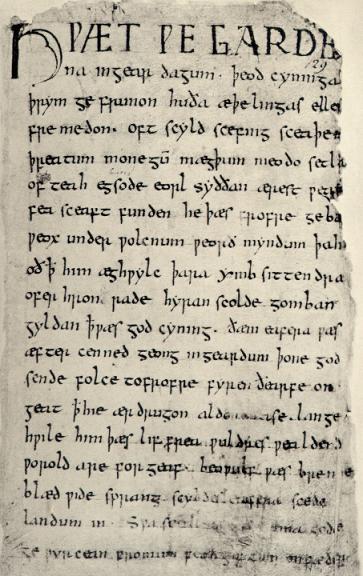 |
| Original Manuscript |
What is shown here (insert) is part of the only existing remnant of any Beowulf manuscript, and dates from the 8th to 11th century A.D. It barely survived a fire in 1731 and remained in its burnt binding until it was rebound in the mid 19th century at the British museum. Without this, it is doubtful any trace of the poem would have ever become known otherwise. Now, Beowulf, from this one manuscript, has become a standard in English literature, a source for linguistic studies in Old English, and a reference for scholars of Scandinavian tribes. Aside from being a great sample of literature from the dark ages, very little is known about the poem or the poet. We, for example, don't know who wrote it or when it was written. We don't know if it is the work of a single man or the accumulation of an oral tradition like the Gilgamesh Epic (or the Bible!). What we do know about it, we have extracted from the poem itself, such as what era and region the English used is from and other historical references found within such as the tribes of the Geats and Swedes.
While reading you may want to consider:
How does the book define a good man or hero? How does it differ from the Greek tradition of a hero in The Odyssey?
The book is written by a (most likely) Christian Anglo-Saxon (Early English) about Scandinavian Pagan heroes, this is considered an interesting irony by scholars. What is your impression?
Based on ideas and excerpts in the poem do you feel that the writer is a Christian or a pagan?

No comments:
Post a Comment