Much like my experience with Frankenstein, my only exposure to Beowulf was the animated film "starring" Angelina Jolie. I never had to read it as part of my literature curriculum like most people seem to have had to. As I mentioned in prior ramblings, I probably wouldn't have enjoyed it anyway at that age. That being said, I have fairly mixed feelings about it now. It certainly was a bit richer than some of the other translations I perused prior to buying this one, and in general, I thought the poem was interesting and moderately enjoyable, but I feel this is one of those works that require multiple readings to fully appreciate.
Allow me to, first, describe what I liked about it. It had an air of familiarity with its heavy formalities involving guests. Beowulf arrives at the land of the Danes and tales are told and gifts are exchanged for several pages before he announces why he is there and then the compliments and gift giving begin again. Readers may find this similar to the Greek courtesies toward guests and strangers found in the Odyssey where food and comfort is offered first and foremost, even before names are exchanged. Interestingly, despite this observation, this society is less polite than most. This is a warrior based culture and Unferth, the King's aide, and Beowulf are not afraid to trade insults and Beowulf's only speeches are boasts of what he has done and will do.
I also liked that this has the feeling of an Anglo-Saxon "tall-tale." Beowulf is the warrior version of Paul Bunyan able to do deeds no other man can accomplish. I feel this is different than the Greek tales of Herakles (Hercules) which seems more tied to the gods and the Greek religion than this. This has an interesting feeling of being grounded in reality despite the the monsters and dragons. I almost feel that these are make believe tales of a man that once existed. Reading this almost makes me wonder if there was a beast called Grendel. He kills the beast by removing its arm and it escapes and dies on its own, that is a weird way to tell of a triumph. That is far different that the standard tale of lopping off its head or sending a spear through its heart with a decisive win. That is why it has the strange feeling of being real to me, the telling is too unusual. The lineages of both tribes also lend it a flavor of reality with the names of major kings going back several generations.
Another thing that I liked was the particular cadence of the prose:
"So Grendel ruled in defiance of right,
one against all, until the greatest house
in the world stood empty, a deserted wallstead"
This style of cadence almost gives it the feel of a harmonic chant. I can imagine this being recited by a bard in a gathering of Anglo-Saxons centuries ago. If you pay attention to to the wording you will also pick up on the alliterative style of poetry. "...their wassail was over, they wept to heaven / and mourned under morning. Their mighty prince." You should keep in mind that the translator,Seamus Heaney, was trying to preserve the feel of the original poem and chose his words to use carefully to mimic the same alliteration.
One of the things I did not like about the poem was that Beowulf dies before the end of the poem and we have to spend many pages recalling the feats of a previous king and his heirs and why the Geats may be attacked and then the poem jumps back to Beowulf's last requests being fulfilled. This may seem like a minor issue but the reader has to push through a cast of new characters performing deeds in the past that has little bearing on the story. This actually occurs more than once where we read a story within a story, the feats of previous heroes and kings as well as Beowulf's past deeds. We also have to hear Beowulf recap how he killed the mother of Grendel right after he completes the task.
Perhaps one day after I have explored all of the other works that have attracted my attention, I may see a need to further explore this epic one day and maybe pick it apart in a more scholarly fashion (though doubtfully) but in the meantime there are too many books and so few evenings to read them in!
Saturday, April 23, 2011

Saturday, April 9, 2011
April Selection: Beowulf - author unknown
This month we will be reading Beowulf! I have selected Seamus Heaney's New Verse Translation: Bilingual Edition for its ease of use and nice introduction. The pages are set up with the Old English script on the left page on the new translation on the right. We won't be using the Old English version, of course, but its there for those who are curious. My favorite thing about this edition is that a synopsis of events are notated in the margins making it easy to reference later and it helps clarify things for those who may find the poetry difficult. However, readers should not be daunted by that, I have discovered the text to very easy to read and understand so far. I doubt that anyone will experience any difficulty at all.
What is shown here (insert) is part of the only existing remnant of any Beowulf manuscript, and dates from the 8th to 11th century A.D. It barely survived a fire in 1731 and remained in its burnt binding until it was rebound in the mid 19th century at the British museum. Without this, it is doubtful any trace of the poem would have ever become known otherwise. Now, Beowulf, from this one manuscript, has become a standard in English literature, a source for linguistic studies in Old English, and a reference for scholars of Scandinavian tribes. Aside from being a great sample of literature from the dark ages, very little is known about the poem or the poet. We, for example, don't know who wrote it or when it was written. We don't know if it is the work of a single man or the accumulation of an oral tradition like the Gilgamesh Epic (or the Bible!). What we do know about it, we have extracted from the poem itself, such as what era and region the English used is from and other historical references found within such as the tribes of the Geats and Swedes.
While reading you may want to consider:
How does the book define a good man or hero? How does it differ from the Greek tradition of a hero in The Odyssey?
The book is written by a (most likely) Christian Anglo-Saxon (Early English) about Scandinavian Pagan heroes, this is considered an interesting irony by scholars. What is your impression?
Based on ideas and excerpts in the poem do you feel that the writer is a Christian or a pagan?
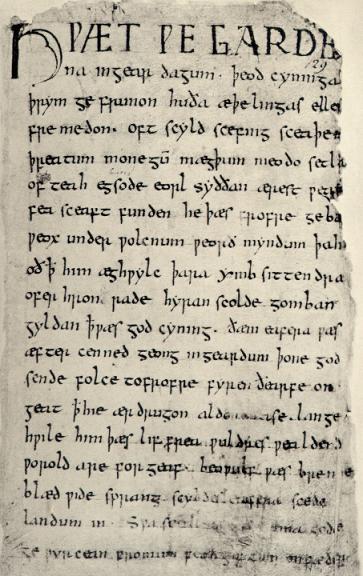 |
| Original Manuscript |
While reading you may want to consider:
How does the book define a good man or hero? How does it differ from the Greek tradition of a hero in The Odyssey?
The book is written by a (most likely) Christian Anglo-Saxon (Early English) about Scandinavian Pagan heroes, this is considered an interesting irony by scholars. What is your impression?
Based on ideas and excerpts in the poem do you feel that the writer is a Christian or a pagan?
Monday, April 4, 2011
Impressions on Frankenstein
Hey folks! I hope everyone enjoyed Frankenstein as much as I did. Looking back at my introduction on Frankenstein, I realize that I failed to mention that I had made an attempt to to read it about five years ago. I attempted at a time when I was seeking out gothic fiction from the same era (or earlier) or even similar gothic pulp fiction from the late 1800's (Poe) to the early 1900's (Lovecraft) onward. At the time I was seeking cobweb laden castles riddled with trap-doors, secret passages, and the faint stirrings of ghosts. Approaching Frankenstein at that time was a mistake; there were no castles, "the monster" was all too human, and Frankenstein was a miserable crybaby. Needless to say, I got bored with it halfway and read The Monk by Matthew Lewis instead (and loved it, by the way!) Now, I must admit that I am glad that I approached Frankenstein once again. This time I enjoyed it thoroughly.
Is this a gothic novel? Although it lacks the aforementioned castles and cobwebs as well as other gothic archetypes like sinister authority figures or ancestral curses, it is indeed a gothic novel. Try to remember the misty mountains the monster resides in or the fog shrouded lake where Frankenstein disposes of his abandoned female creation and you will see the similarities. But, I believe that it is Shelley's deviation from the standards of gothic fiction that helped cement her book as a classic that is still read today.
I mentioned earlier the alternate title "The Modern Prometheus" for purposes of discussion. As I doubt there will be any actual discussion, I will touch on it lightly for any readers who happen by. To sum up the Greek myth of Prometheus; humankind tricked Zeus into accepting displeasing offerings as sacrifices so Zeus hid the mystery of fire from humanity. Prometheus stole it back and gave it to mankind. Zeus punished him by having him chained to a rock and having an eagle eat out his liver daily only to have it grow back overnight. In comparison to the novel Frankenstein we can see that it is the concept of forbidden knowledge and the punishment that goes with it that Shelley is trying to address. Prometheus loses his liver each day, Frankenstein loses his friends, family, wife, wealth, and life for the forbidden knowledge of the mystery of life.
For those who are curious about the differences between the film and book, I will mention some of the main ones here. First, just to let you know, there are no similarities other than a few names and locations. The monster is large in both works but in the novel he is also swift and intelligent as well as devious and emotional, not the lumbering moaning creature portrayed by Karloff. In the film, Frankenstein has a castle where he derives life from the power of lightning. In the book he creates the monster in his apartment but can't remember how. He also does not see the creature for months after he made it because it escaped immediately. As you can see the differences are quite stark and can go on in this vein for several paragraphs.
The theme of abortion also permeates the novel. I personally feel this is almost too obvious (and weak, at that) to be worthy of discussion but I will bring it up briefly because it is commonly discussed in conjunction with this work. Frankenstein's creation can be considered an "abortion" in the way that created it and then dismissed it and even tries to kill it. His second creation is a closer abortion in the way that he gathers the parts and disposes of them before it was "born". I am not a fan of this applied metaphor because it breaks down under scrutiny, Frankenstein's creation more closely parallels "child abandonment" than anything else. If you put it to closer scrutiny, the creature ran away when it came to life so really the theme is closer to a "wayward son" premise. Frankenstein was not disgusted with it as he built it (though he was delirious) so who is to say he did not have the capacity to teach it and raise it?
Is this a gothic novel? Although it lacks the aforementioned castles and cobwebs as well as other gothic archetypes like sinister authority figures or ancestral curses, it is indeed a gothic novel. Try to remember the misty mountains the monster resides in or the fog shrouded lake where Frankenstein disposes of his abandoned female creation and you will see the similarities. But, I believe that it is Shelley's deviation from the standards of gothic fiction that helped cement her book as a classic that is still read today.
I mentioned earlier the alternate title "The Modern Prometheus" for purposes of discussion. As I doubt there will be any actual discussion, I will touch on it lightly for any readers who happen by. To sum up the Greek myth of Prometheus; humankind tricked Zeus into accepting displeasing offerings as sacrifices so Zeus hid the mystery of fire from humanity. Prometheus stole it back and gave it to mankind. Zeus punished him by having him chained to a rock and having an eagle eat out his liver daily only to have it grow back overnight. In comparison to the novel Frankenstein we can see that it is the concept of forbidden knowledge and the punishment that goes with it that Shelley is trying to address. Prometheus loses his liver each day, Frankenstein loses his friends, family, wife, wealth, and life for the forbidden knowledge of the mystery of life.
For those who are curious about the differences between the film and book, I will mention some of the main ones here. First, just to let you know, there are no similarities other than a few names and locations. The monster is large in both works but in the novel he is also swift and intelligent as well as devious and emotional, not the lumbering moaning creature portrayed by Karloff. In the film, Frankenstein has a castle where he derives life from the power of lightning. In the book he creates the monster in his apartment but can't remember how. He also does not see the creature for months after he made it because it escaped immediately. As you can see the differences are quite stark and can go on in this vein for several paragraphs.
The theme of abortion also permeates the novel. I personally feel this is almost too obvious (and weak, at that) to be worthy of discussion but I will bring it up briefly because it is commonly discussed in conjunction with this work. Frankenstein's creation can be considered an "abortion" in the way that created it and then dismissed it and even tries to kill it. His second creation is a closer abortion in the way that he gathers the parts and disposes of them before it was "born". I am not a fan of this applied metaphor because it breaks down under scrutiny, Frankenstein's creation more closely parallels "child abandonment" than anything else. If you put it to closer scrutiny, the creature ran away when it came to life so really the theme is closer to a "wayward son" premise. Frankenstein was not disgusted with it as he built it (though he was delirious) so who is to say he did not have the capacity to teach it and raise it?
Subscribe to:
Comments (Atom)